Sport Psychology and Training Indoors
Welcome to the thick of winter in the Northern Hemisphere! The snow is falling and the temperature has us heading indoors to get our training done, well maybe not all of it. For some there is nothing like running on freshly fallen snow or braving that cold to go for a bike ride. However, there are times where the weather just does not allow us to head outside to get our training done. While this blog post has runners, cyclists, and triathletes in mind when it comes to indoor training, cycling will be used as the discussion example.
Chances are that many people dread the thought of training indoors because the experience is not the same. There are not the same cues that people experience when they are outdoors training such as the wind, sights, and a chance to practice cornering. That can make the experience not as enjoyable. We all lack the opportunity to practice certain skills, like cornering, but at the same time gain the opportunity to practice others, like cadence. On the other end of the spectrum some people do enjoy the safety of the trainer and the chance to watch a movie or listen to a book while spinning their legs. Either way, there are some things that you may want to keep in mind when it comes to your “mind.”
Use mindfulness to your advantage!
Our minds are great at wandering off! Maybe they are too good at it. When our minds wander off we tend to lose a little focus. Think about a time when you may have checked your cell phone or was having a conversation with a family member who came by to say hi. What happened? Did your cadence or speed slow? Chances are that it did because you were not focused on your cycling. Purposefully bring your mind back to the present moment by noticing your pedaling or breath.
Activate your positive self-talk!
If you notice that your thoughts have become more focused on the negative, remember the power of self-talk. Your self-talk can help improve your performance and experience or make it worse. Research continues to remind us how interlinked our self-talk and emotional processes are including emotional regulation (Fritsch et al., 2024). Remember to invite self-talk that is realistic, thoughtful, and encouraging. So when thoughts about how boring the ride is, how “unskilled” or uncomfortable this ride is, or even how painful the workout is, flip the script and build yourself up.”I’m getting stronger.” “I’m enjoying the chance to practice my cadence.” “I made it onto my bike.”
Invite visualization into the session.
Visualization is talked about a lot in sport psychology (Stephen et al., 2022). It can be used here as well. Visualize the workout being successful or what it might be like to racing against someone or on an imaginary course. With the advent of technology and the ability to ride specific courses using software and smart trainers, visualizing courses becomes a little easier. That doesn’t mean you can’t spice it up by visualizing crowds and a race to the end when you have a challenging interval.
Focus your attention where it needs to be.
This harkens back to the above discussion about mindfulness. Being mindful allows people to direct their attention. On the trainer, we can think about activating certain muscles, hello glutes!, making sure that we are pushing and pulling throughout the pedal stroke, or addressing our cadence. When you bring your awareness/focus/attention to something like a skill or experience, it makes it all the more powerful and engaging. Translation - You get more out of your workout.
Goals!
Yes, goals are here to stay. Goals tend to creep up everywhere in sport psychology and for good reason. In this case, we come back to the topic of process goals that we can use during the ride. Process goals, in the research, continue to have the largest impact on performance, and self-efficacy (Williamson et al., 2024). What needs your attention during this training session? What skill can be the focus of your time? Make that your goal to help keep your engagement higher.
What is discussed in this blog post is nothing new or revolutionary, rather it is practical and a reminder that even if we are forced to ride, run, or train indoors, there is still opportunity. Do not waste the opportunity! It is there for the taking!
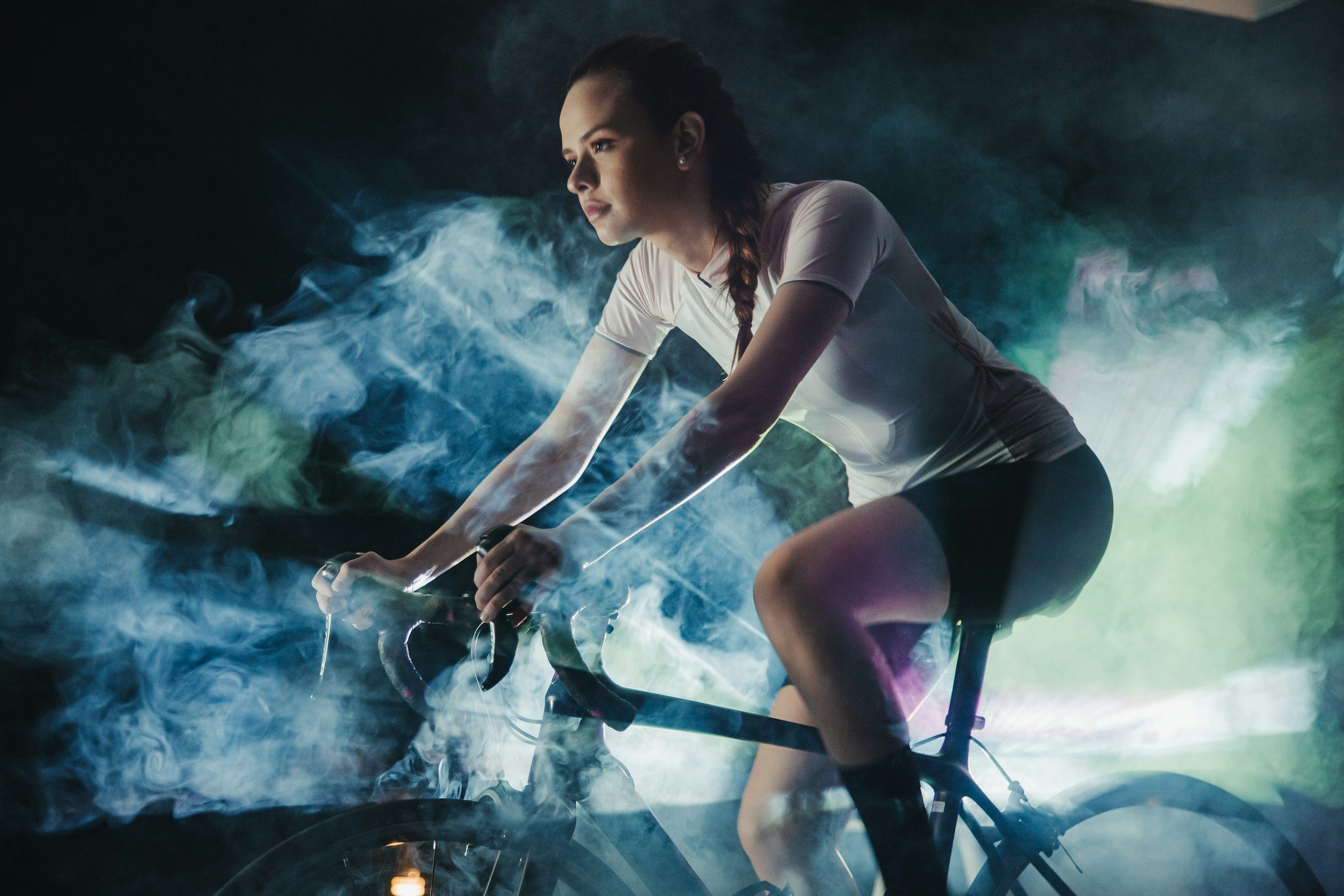
A person wearing a white short sleeve shirt and black cycling shorts on a bike. There is smoke in the background with white, blue, and green lights.
take action today moment:
Give some of the suggestions a try! See what you notice and what works. Not every suggestion will work for everyone, but you will not know until you try!
References
Fritsch, J., Feil, K., Jekauc, D., Latinjak, A. T., & Hatzigeorgiadis, A. (2024). The relationship between self-talk and affective processes in sports: A scoping review. International Review of Sport and Exercise Psychology, 17(1), 482-515. https://www.tandfonline.com/doi/abs/10.1080/1750984X.2021.2021543?journalCode=rirs20
Stephen, F. A., Ermalyn, L. P., Mangorsi, B. Y., Louise, L. J., & Juvenmile, T. B. (2022). A voyage into the visualization of athletic performances: A review. American Journal of Multidisciplinary Research and Innovation, 1(3), 105-109. https://doi.org/10.54536/ajmri.v1i3.479
Williamson, O., Swann, C., Bennett, K. J., Bird, M. D., Goddard, S. G., Schweickle, M. J., & Jackman, P. C. (2024). The performance and psychological effects of goal setting in sport: A systematic review and meta-analysis. International Review of Sport and Exercise Psychology, 17(2), 1050-1078. https://doi.org/10.1080/1750984X.2022.2116723