Building Creativity for Athletes
How often do people hear creativity, sports, and athletes in the same sentence? Chances are rare, if at all Yet, creativity can be one of the most essential topics in sports (Fardilha & Allen, 2020; Rasmussen et al., 2019). When we think about athletic creativity from a sport psychology perspective, many minds go to encouraging exploration, varied training, and open-ended problem solving, thus encouraging athletes to expand their flexibility and ability to identify novel solutions. The result is increased confidence and performance from the exposure to the above ideas, in addition to other topics such as the introduction of novel ideas, the use of visualization, and adapting creative mental exercises, like role-playing and including creative non-sport activities. Mouth full! Yep! So let’s break this down a little bit and make it fun.
Creative Approaches
Training Environment
Let’s start by talking about the training environment. Change it up! By altering the environment, it encourages us to find novel solutions because we have to think on our feet and adapt to something new. When changing the environment, rules could be altered or additional constraints could surface that are new. For example, maybe while playing soccer on the field, additional obstacles are put onto the field with the rule being that before a player can score they must go around at least two obstacles. Talk about changing it up! Not only do individual players have to adapt but the whole team does as well!
Enrichment Exposure
Take the opportunity to expose athletes to a variety of different movements, techniques, and problem solving strategies through means such as observing other players, teams, or even other sports.
Open Instructions
Consider the power of language. When we use narrow language, we limit our’s and other’s ability to consider finding other ways of looking at things. Instead, use language that is broader that encourages tactical thinking. For example, “use all available information to reach the goal.” This type of language encourages an athlete to consider all avenues rather than just thinking about one possible avenue.
Classic Techniques Never Go Out of Style
Visualization/imagery, mindfulness, relaxation, and self-talk are still applicable to help build creativity. During visualizations, athletes can try creative plays and experience peak performance, which can help athletes experience these states. Furthermore, mindfulness and relaxation exercises help athletes keep focused on clearer, less stressed thinking, which allows the brain the opportunity to think more creatively.
Creative Experience Outside of Sports
It is okay to encourage athletes to participate in artistic activities such as music, writing, painting, dancing, etc. to help with emotional balance and even give them an experience of creativity in another realm.
Have Fun!
It's okay to have fun! Children learn through play (Whitebread et al., 2009) and so can adults (Zosh et al., 2017). During training, take opportunities to make things fun whether through playing games or finding challenges that build intrinsic motivation.
So, why does any of this matter? Why do we want to encourage creativity within athletics? Because of the many benefits such as enhanced problem solving, increased confidence, greater enjoyment of sport, and mental resilience. Research supports the idea that creativity supports athletes in developing situated potential as well as supporting the capacity to search for, handle, and/or create novel situations (Rasmussen et al., 2019). Beyond the benefits that athletes reap from building creativity, it just might remind us all how much we love our sport and why we all show up in the early morning or stay up late, miss other experiences to train, etc. And, in case this point was not made clear earlier - give us all the chance to grow and have fun while doing so.
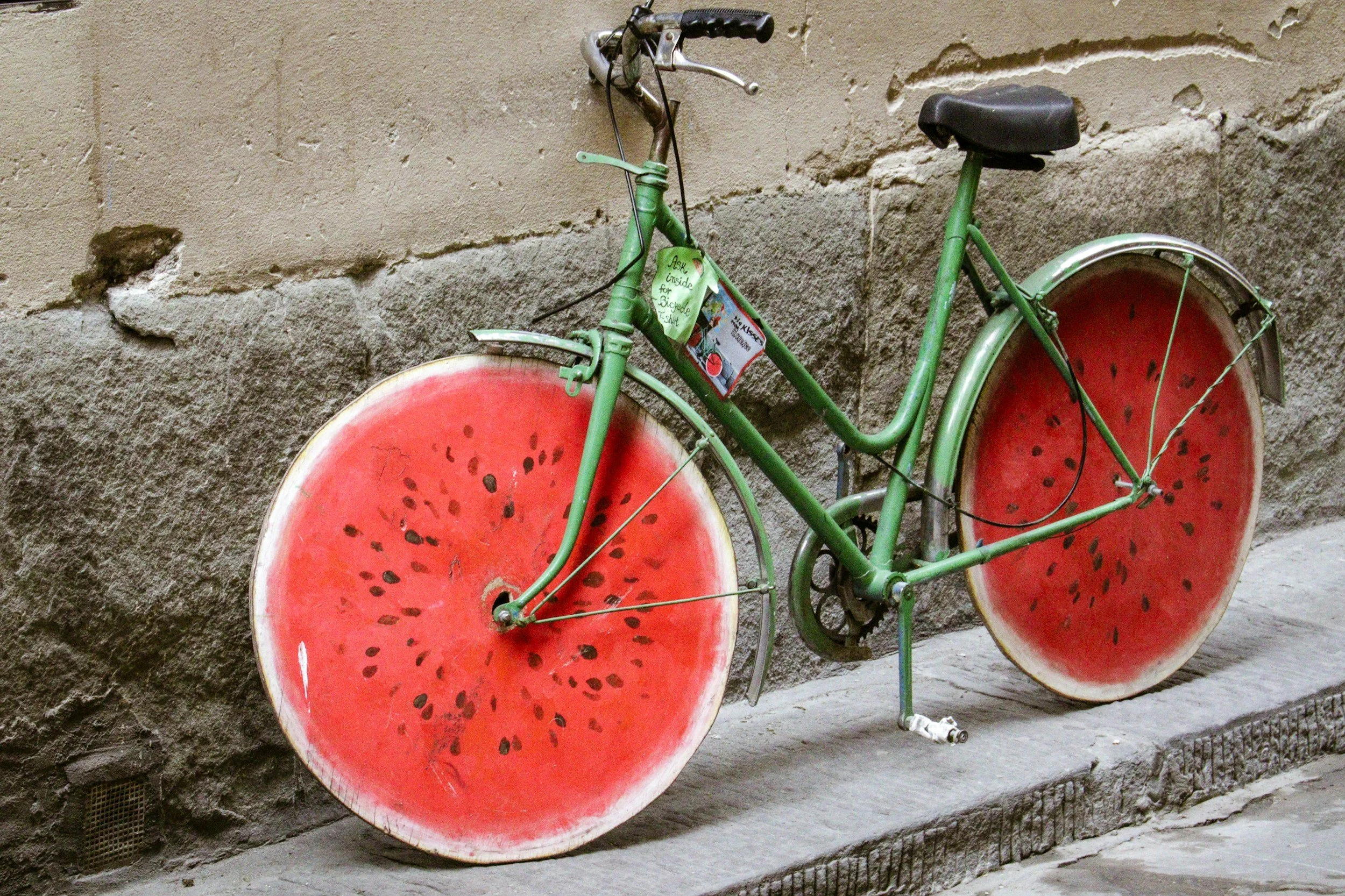
A green bicycle with wheels that look like the inside of a watermelon.
take action today moment:
Give some of the above suggestions a try whether you are an athlete or a coach. Experiment with different exercises and combinations till you find what works best for you or your athletes. Throughout the process, remember that the goal is to exercise creativity and build that as an essential skill.
References
Fardilha, F. D. S., & Allen, J. B. (2020). Defining, assessing, and developing creativity in sport: A systematic narrative review. International Review of Sport and Exercise Psychology, 13(1), 104-127. http://www.tandfonline.com/10.1080/1750984X.2019.1616315
Rasmussen, L. J., Østergaard, L. D., & Glăveanu, V. P. (2019). Creativity as a developmental resource in sport training activities. Sport, Education and Society, 24(5), 491-506. https://doi.org/10.1080/13573322.2017.1403895
Whitebread, D., Coltman, P., Jameson, H., & Lander, R. (2009). Play, cognition and self-regulation: What exactly are children learning when they learn through play?. Educational and Child Psychology, 26(2), 40-89.
Zosh, J. M., Hopkins, E. J., Jensen, H., Liu, C., Neale, D., Pasek, K. H., Solis, S. L., & Whitebread, D. (2017). Learning through play: A review of the evidence.