What Do Rugby and Artistic Swimming Have in Common? Part 1
Yes, this is the topic of today. Really! In fact, this will be the topic for this week and next week as we dive into the world of two sports that need some more attention. To begin, we need to cover the basics of both sports to level the playing field.
Rugby
A full-contact team sport, rugby, uses an oval ball to score via carrying, backwards passing, or kicking into the opposing team’s in-goal area to score a “try,” or kicking the ball through H-shaped goal posts. The objective, as one would guess, is to score the most points (Gabbett, 2005). 15 player teams (Rugby Union) may experience tackles, rucks, and scrum on a grass pitch with two halves. Rugby Sevens is a team of 7 players that often comes with a faster and shorter game. Games are fast-paced and continuous and require mental toughness, trust and mutual respect for teammates, discipline, cooperation, teamwork, endurance and dedication. Play is only stopped briefly for fouls, injuries, or the ball landing out of bounds.
Teams score as mentioned above in two ways. Players may run with the ball, but the ball must be passed or handed backward as forward passes are illegal. However, kicking forward is allowed. When a team is in the defensive role, players may tackle the ball carrier, but must release the player and ball upon completion of the tackle. In the process of working to score, players and teams may experience what is called a scrum. A scrum is a way to restart the game after a minor infringement. The forwards from both teams bind and push as a way to obtain control of the ball. A line-out occurs when the ball touches or goes out of bounds, with players lifting their teammates with the intent to catch the thrown-in ball. Finally, points are accumulated through a try or touching the ball down which earns 5 points followed by a commutation kick. Additionally, points may be earned from penalties or drop kicks. While rugby is a major sport in certain areas of the world, in the U.S. rugby is considered a minor sport.
This is just a basic description to help launch us into our discussion. The next sport this post will introduce is artistic swimming.
Artistic Swimming
Swimming itself has played an important role across continents and throughout societies across time (Vasile et al., 2023). In other words, swimming is important in human history. Artistic swimming, once known as synchronized swimming, combines swimming, dance, and gymnastics to perform synchronized, choreographed routines in the pool to music (Ntomali et al., 2021). This sport takes power, strength, agility, timing, flexibility, and breath control to successfully complete the intricate movements, lifts, and acrobatic patterns. Additionally, artistic swimmers need stamina and coordination whether they are competing in the solo, duet, mixed duet (mixed genders), or team (up to 8 swimmers) formats. The swimmers are judged on execution, difficulty, and artistic impression. Like every sport there are rules that the swimmers must follow. For example, swimmers may not touch the bottom or sides of the pool and must remain in the water for more than 10 seconds. For as amazing as these athletes are, artistic swimming is considered a minority sport, thus having limited social and economic impact (Rincón et al., 2023).
What Do They Have in Common?
Now that you know the basics, and the above really are just the basics, as there is much more nuance, the discussion turns towards what these two sports have in common.
Physical Demands
Both rugby and artistic swimming require high levels of fitness, strength, and stamina. Explosive power is necessary for the jumps the artistic swimmers perform. Force and endurance are needed for running and tackling in rugby (Gabbett et al., 2008).
Breath Control and Core Strength
Artistic swimmers have amazing breath control, as they must be able to hold their breath underwater for long periods of time while doing complex moves. Good core strength and breath control are needed for impact and tackling while playing rugby.
Teamwork
Teamwork makes the dream work! Both artistic swimming and rugby require excellent teamwork. Artistic swimmers must remain in sync for the deterioration of the performance while rugby players must work together to coordinate plays to effectively move the ball as a unit.
Power and Agility
Yes, both artistic swimmers and rugby players need power and agility. Rapid, powerful thrusts are needed to execute moves like the barracuda kicks. Rugby players must use explosive power and agility to break tackles and complete different plays (Gabbett et al., 2008).
Mental Toughness
Both rugby and artistic swimming ask athletes to be mentally tough to execute their necessary skills. Much focus, discipline, and resilience is needed to be successful, especially under pressure.
Body Control
Athletes need to know their bodies to be effective in their sport. Athletes spend many hours honing their awareness and skills. The precise body angles and movement of the artistic swimmers and the exceptional body control of rugby players on the field highlight this importance.
High-Impact Nature
While one would not necessarily think that artistic swimming is high impact, it truly is a high-impact sport via the lifts and acrobatics. Rugby players experience tackling and rucks on land.
How often do we even think about comparing rugby and artistic swimming? Probably not too often, however, there is an important reason to explore these two sports and next week we will dive more deeply into this topic. In the meantime, spend some more time learning more about these two amazing sports.
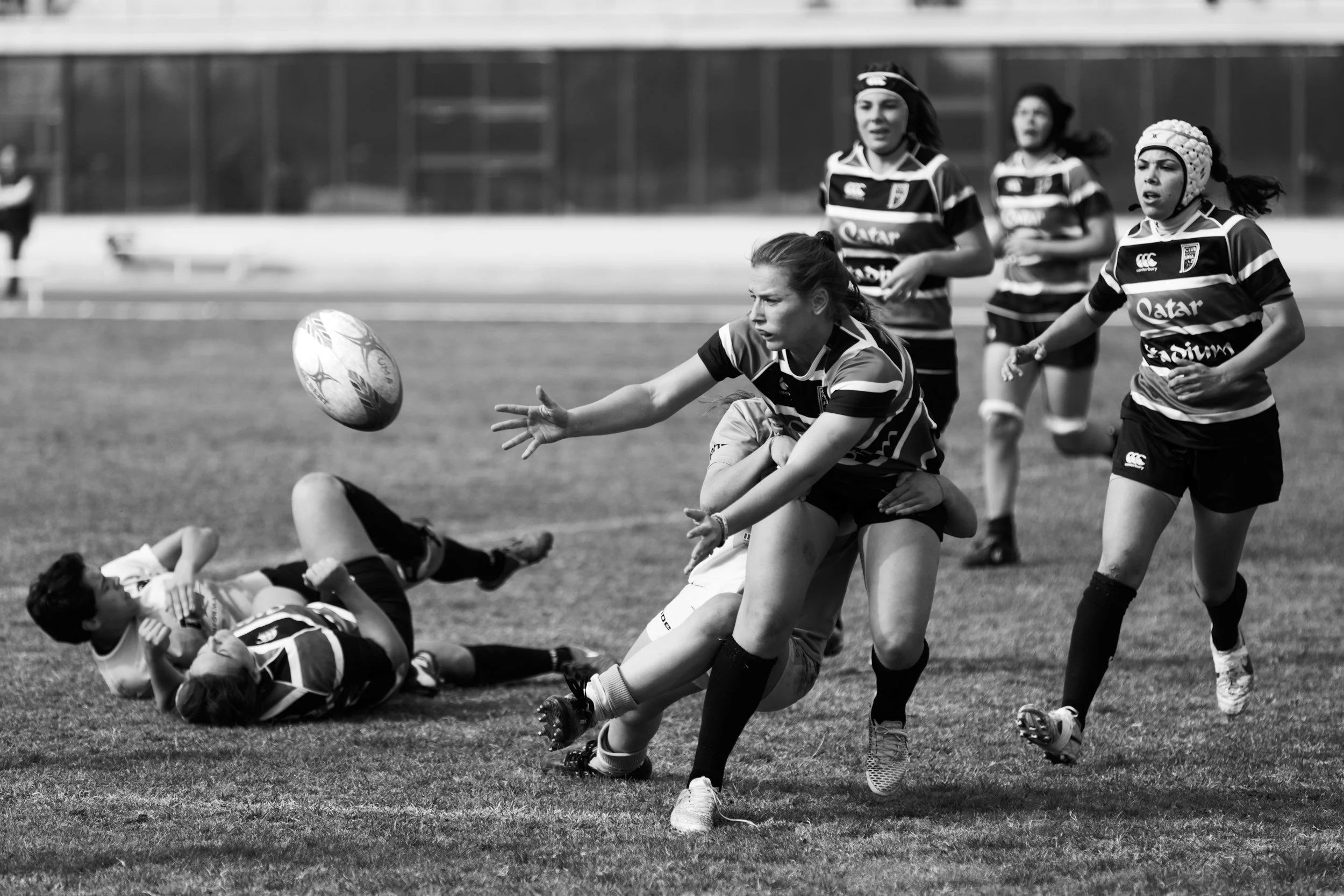
Rugby players with long hair wearing uniforms playing rugby.
take action today moment:
Take some time to learn more about rugby and artistic swimming. Everyone is also very much encouraged to check any biases or assumptions they have about either sport. This will be important for next week.
Learn More About Rugby and Artistic Swimming:
References
Gabbett, T. J. (2005). Science of rugby league football: A review. Journal of Sports Sciences, 23(9), 961-976.
Gabbett, T., King, T., & Jenkins, D. (2008). Applied physiology of rugby league. Sports Medicine, 38(2), 119-138. doi: 0112-1642/08/0002-0119/$48.00/0
Ntomali, S., Adamakis, M., Venetsanou, F., Chairopoulou, C., & Psychountaki, M. (2021). Which factors are influencing artistic swimming performance?. European Journal of Physical Education and Sport Science, 6(12), 62-76.
Rincón, A. B., Trinidad, A., & López-Valenciano, A. (2023). Bibliometric study on artistic swimming. Frontiers in Sports and Active Living, 5, 1196144. https://doi.org/10.3389/fspor.2023.1196144
Vasile, L., Ticala, L., Rădulescu, A., Mujea, A. M., Matei, C., Branet, C., ... & Bălan, V. (2023). A ludic history of swimming–A systematic review. Discobolul-Physical Education, Sport & Kinetotherapy Journal, 62(2), 189-207.