What Do Rugby and Artistic Swimming Have in Common? Part 2
Welcome to part 2 in this series about artistic swimming and rugby. Hopefully, last week encouraged everyone to learn more about both of these sports and any associated biases. Now it is time to look at these two sports through the lens of stigma. While these two sports may seem vastly different, how they are impacted by stigma brings them closer together as they are often misunderstood by the general public. These misconceptions include the nature of their athleticism, the intense physical impacts, and the gender-based stereotypes. Let’s begin our exploration on the impacts of stigma on these two sports.
Athleticism and Trivialization
Both sports require great skill and athleticism. Let’s begin artistic swimming. Often viewed as “synchronized swimming” with glamorous costumes and styled hair, artistic swimming is often viewed as a performance rather than a challenging sport. People often fail to understand the immense cardiovascular conditions, anaerobic endurance, and strength needed to execute the moves while holding one’s breath for up to 2 minutes. The swimmers make it look so easy, but try to stay in synchrony with the other swimmers, while holding your breath, and performing challenging movements. It is not as easy as it looks. Transitioning to rugby, people often consider it a violent sport and thus dismiss the necessary technical skills, endurance, and tactical intelligence needed to be a skilled player. The sport is thus reduced to thinking about brute force as the method for winning.
Gender Stereotypoes
Sports are not immune from gender stereotyping. Within the context of both sports, there is the insidiousness of traditional, limiting views of gender. This topic deserves a longer discussion and that will come in future blog posts. For now, this post will just scrape the surface of a complex and worthwhile topic. Women’s rugby will start this brief discussion. The players may be described as not being “real women,” or have their sexuality questioned for stepping into a sport that is seen as a “masculine” domain (Dane et al., 2024). In the artistic swimming world, the sport is seen as a female-dominated sport and, as such, is stereotypically considered “feminine” or “soft” (Yang et al., 2025). This view can lead to the marginalization of male-identified swimmers. At times, the perception of a focus on makeup and costumes can lead people to think of the athletes as being hyper-sexualized rather than athletes.
Risk and Safety
The narratives and misconceptions surrounding both sports minimize the risks for both sports, thus leading to a stigma about participating in the sports. Rugby is often viewed as excessively dangerous almost to the point of being reckless, which may steer caregivers from allowing or encouraging children to participate, despite rules in place meant to protect safety. When it comes to artistic swimming, appearances are not always the reality. The swimmers make their routines appear graceful. However, the truth of the experience is different. Artistic swimmers are engaged in a high-impact sport that exposes them to injuries, concussions, and in some extreme cases, loss of consciousness arising from oxygen deprivation.
Physical Intensity
To watch a rugby game or an artistic swimming competition, one might observe how effortless the swimmers make their routines appear, while the rugby players may exhibit a sense of control that masks the intense physical strain.Therein lies another connection between rugby and artistic swimming. Artistic swimmers must be strong enough to execute their routine and lift teammates out of the water while treading water. Rugby players must be able to endure extreme impact and maintain a strong running endurance. Simply said, rugby players and artistic swimmers experience what is known as a paradox of perception. The more skilled and efficient athletes are at their chosen sport, the more people can fail to recognize the necessary physical and mental demands of the sport, leading to a stigma that undermines the legitimacy of the sport.
Mental Health
Within the sports world there is a general stigma around seeking mental health services (Kola-Palmer et al., 2020). Rugby and artistic swimming are not exempt from this stigma. The expectation of being mentally tough and resilient is centered, which means athletes who do seek help are often perceived as weak. To avoid this consequence athletes may hide their struggles. In artistic swimming, the high intensity of the performance narrative and aesthetic judging contribute to an environment that intensifies mental health issues. In rugby there does seem to be a need for psychological support to be available, but a limited number of players access it (Green et al., 2012).
Performance Pressure and Athlete Identity
Athlete identity is the degree to which people see themselves as an athlete, thus, impacting their self-worth and perception. Again, rugby players and artistic swimmers are not exempt from developing an athletic identity. In some cases the identity can be protective and, in other cases, it can be harmful if there is an overly strong identification. If athletes develop an overly strong identification it can make it very difficult to reach out for support and it can lead to an identity loss if there is a bad injury or after retirement.
Exclusion and Discrimination
Both artistic swimming and rugby face issues around inclusion of transgender athletes. With governing bodies being asked to write strict policies or implement bans, athletes are facing difficult challenges.
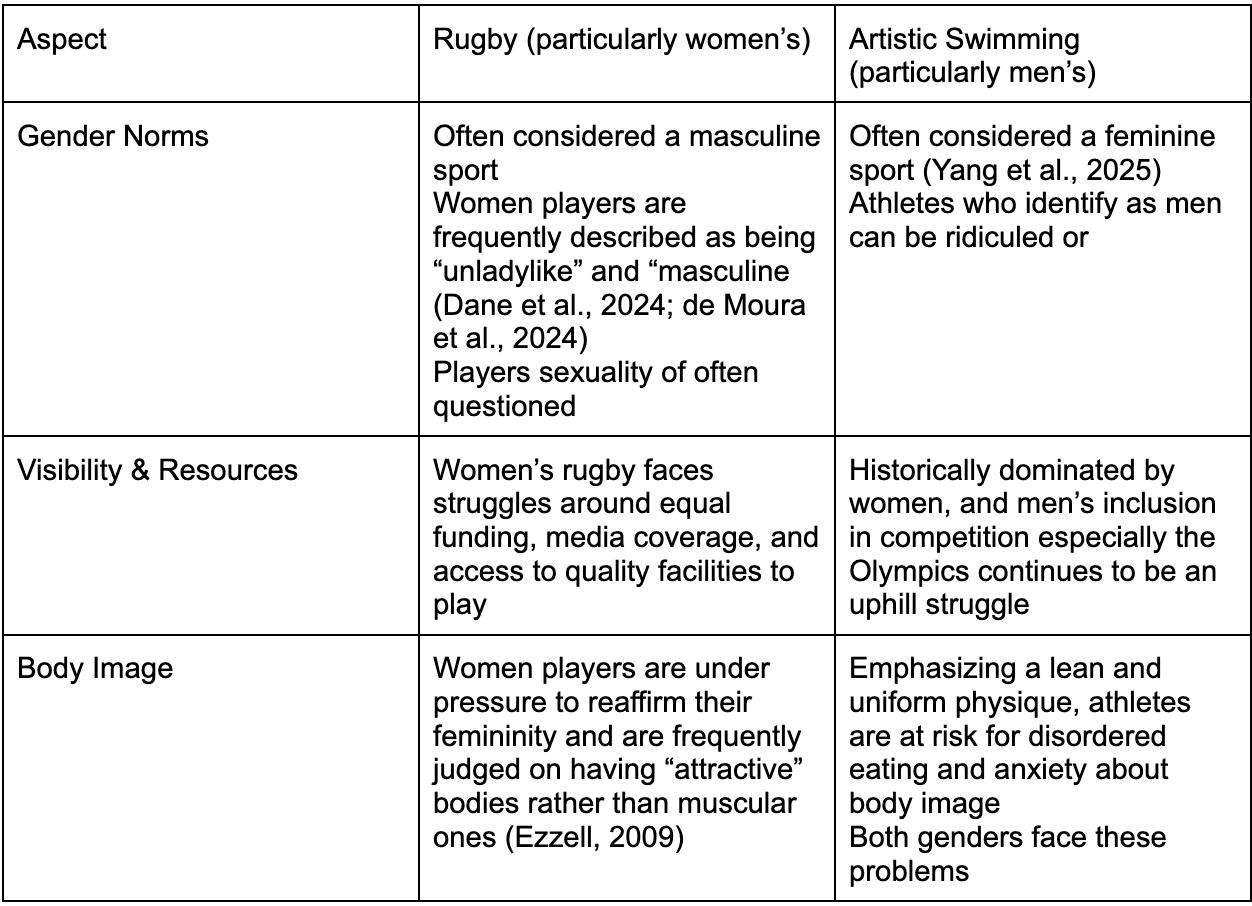
Table comparing rugby and artistic swimming.
What the above table starts to demonstrate is that artistic swimming and rugby are impacted by rigid, traditional gender norms that can foster an environment that leads to challenges for athletes who do not conform to established stereotypes.
This post has only scratched the surface on many of the topics and issues that were discussed. There is so much more to be said. This is just the beginning.
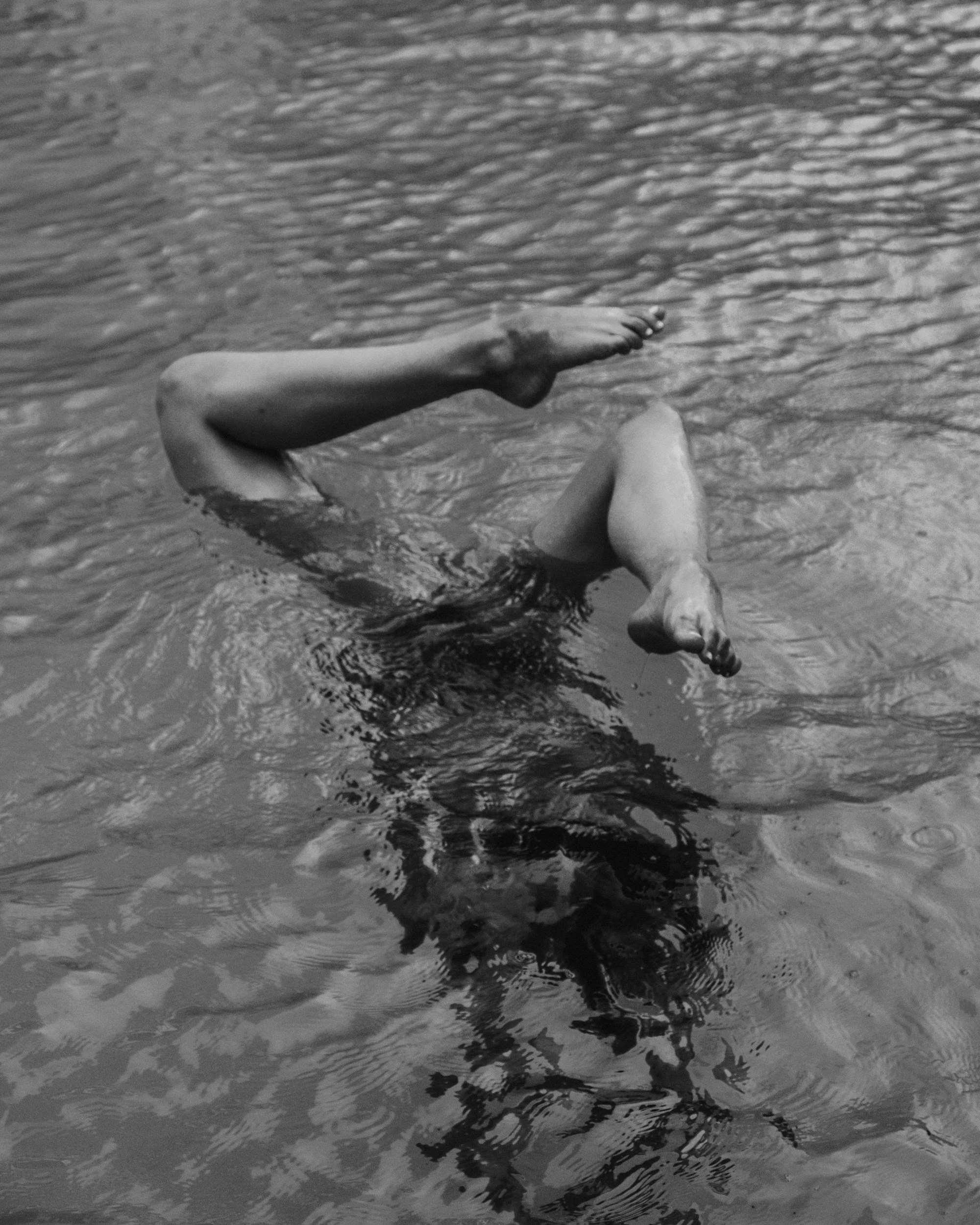
A swimmer with their legs out of the water. Each leg is bent at a 90 degree angle.
take action today moment:
After reading this post, what are your initial thoughts and impressions? What do you agree with and disagree with? What do you want to learn more about? Take the time to dive into some of the topics that you learned about in this post. Begin to challenge yourself to dive into some of the systemic concerns that arise in sport. They are there, and it is important to understand them and how they impact athletes.
References
Dane, K., Foley, G., Cullen, P., & Wilson, F. (2024). “Women shouldn’t play rugby”–the gendered and embodied experiences of women players in rugby union. Qualitative Research in Sport, Exercise and Health, 16(5), 487-502. https://doi.org/10.1080/2159676X.2024.2375395
de Moura, G. X., Pike, E., Malagutti, J. P. M., & Starepravo, F. A. (2024). ‘Male, violent and dangerous’: The gender prejudices in rugby from the perception of current and former athletes of the Brazil women's rugby 7's national team. International Review for the Sociology of Sport, 59(3), 361-380. doi: 10.1177/10126902231204726
Ezzell, M. B. (2009). " Barbie Dolls" on the pitch: Identity work, defensive othering, and inequality in women's rugby. Social Problems, 56(1), 111-131.
Green, M., Morgan, G., & Manley, A. (2012). Elite rugby league players’ attitudes towards sport psychology consulting. Sport & Exercise Psychology Review, 8(1), 32-44.
Kola-Palmer, S., Lewis, K., Rodriguez, A., & Kola-Palmer, D. (2020). Help-seeking for mental health issues in professional rugby league players. Frontiers in Psychology, 11, 570690. https://doi.org/10.3389/fpsyg.2020.570690
Yang, Y., Hu, X. R., & Jiang, K. (2025). The beauty builder: A genealogical analysis of the production of female power and knowledge in artistic swimming. International Review for the Sociology of Sport, 10126902251313852. doi: 10.1177/10126902251313852