Racism in Sports
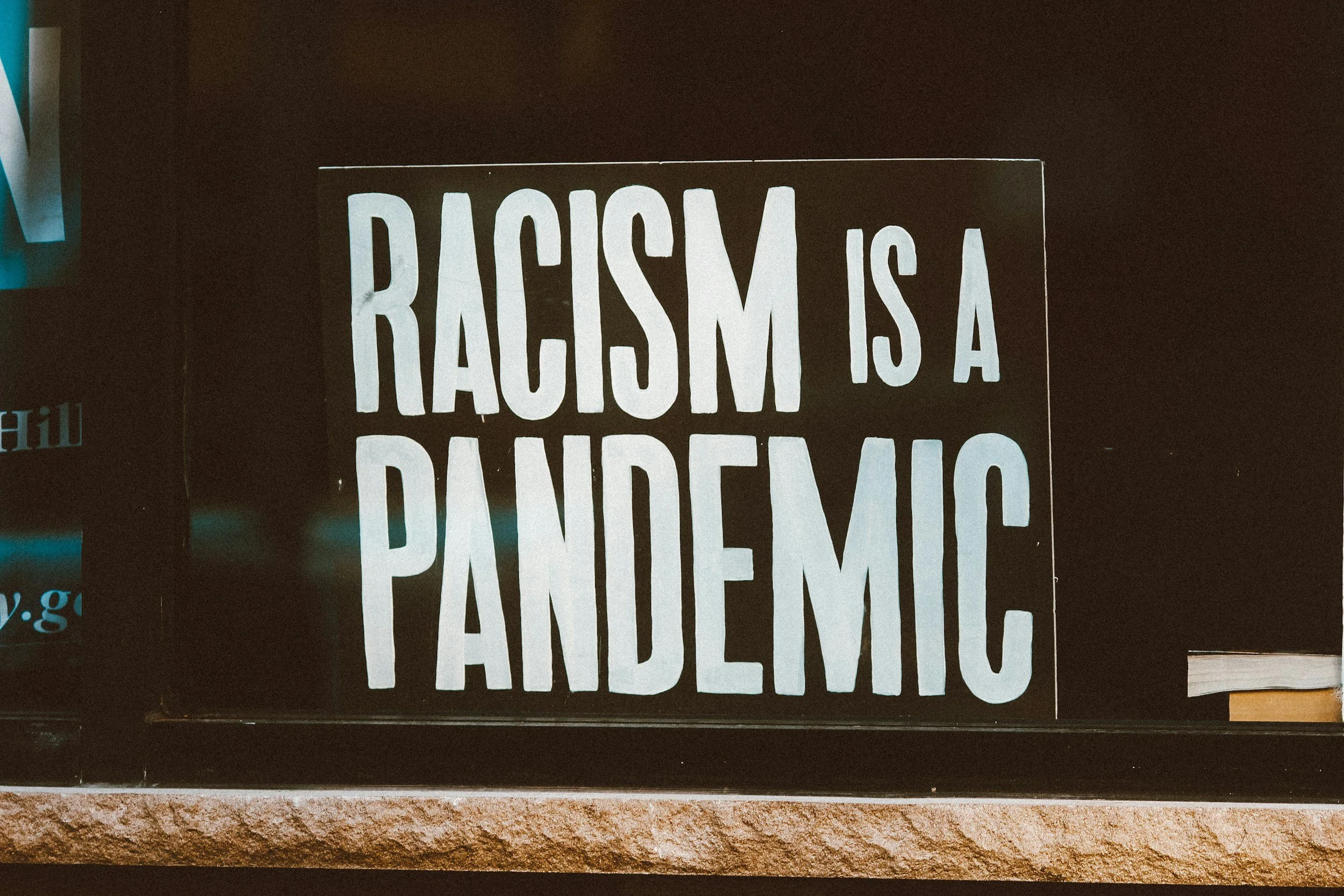
A sign with the words, “Racism is a pandemic,” in white on a black background. To the right are two stacked books.
Last week focused on gender inequity in sports, this week we turn to another systemic issue in sports, racism. These topics can be challenging to dive into, and they are essential topics that must be addressed. This post may be triggering for some, please make sure to take care of yourself. Thank you in advance for diving in and facing racism head on!
Racism takes many forms in sports. Racism shows up in numerous ways and incorporates a multitude of acts and processes that operate on the individual level and the institutional level, either overtly or covertly (Hylton, 2010). We explore racism through three different topics: 1) systemic and structural barriers, 2) spectator and online abuse, hate speech, and microaggressions, and 3) policy bias. There is so much that could be said about this topic, and this post truly only touches a tiny portion of it. Hopefully, it will inspire everyone to learn more and take a deeper dive into the topic.
Systemic and Structural Barriers
Frequently, sports is seen as a meritocratic institution, where it is thought that natural talent and hard work are what determine level of success; however, systemic discrimination and barriers have a strong influence on one’s chances to participate and succeed in sports (Joseph et al., 2022). As much as we wish that sports were excluded from racism, they are not. That includes the many different levels of environments that sports occur. For example, Black student-athletes face systemic racism, not just in their lives, but also from being an athlete in the National Collegiate Athletic Association (NCAA) (Economou et al., 2023). Racism can also manifest in ways that may seem subtle, but are just as harmful. Racist stacking is another example that we can draw on to look at the barriers. A phenomenon that occurs when Black players are underrepresented in tactical and leading positions, while at the same time, overrepresented in positions that are decentralized and physical, racial stacking can be viewed as institutional racism (Nobis & Lazaridou, 2023). Racism comes in many shapes, sizes, and forms.
Spectator and Online Abuse, Hate Speech, and Microaggressions
Racial slurs, monkey chants, and xenophobic behaviors continue to permeate athletics. While the abuse continues in a verbal format, it has also shifted to social media. When it comes to online hate speech, the impact is felt by fans, athletes, and officials as they can experience racist, sexist, and homophobic abuse in addition to several other types of prejudices (Kearns et al., 2023). Let’s look at a specific example from the English Premier League (EPL). Antonio Rüdiger, a Chelsea defender, experienced racism via social media (Cable et al., 2022). Words have power. While some racism is direct, other forms can be very subtle, like microaggressions. Microaggressions are statements, actions, or incidents that communicate indirect, subtle, or unintentional discrimination against people who hold a marginalized identity. And, they show up in a variety of ways. For example, in coaching, which can lead to negative mental health outcomes (Gearity & Metzger, 2017). However, microaggressions are not just limited to race, but also show up related to gender (Ayala et al., 2021).
Policy Biases
If we look to history to begin this conversation around policy biases, we can easily see the numerous explicit racist policies that have been a part of sports. For example, “Caucasian Only” Clauses that existed. The Professional Golfers' Association (PGA) had such a clause in its constitution that was very clear about only white-identifying players being allowed to be on the tour until 1961. Then there was the segregation of teams (Color Lines) that existed. In this case we can take the National Basketball Association (NBA) or Major League Baseball (MLB) as examples that had official or unofficial policies that intentionally excluded Black players leading to the creation of segregated Black teams. Jumping to the mid-20th century, some NBA teams had unofficial quotes that were intentionally designed to limit the number of Black players. These are just some of the many that we can look to from the past. However, that does not mean that the present does not continue discriminatory and racist practices.
Let’s begin our discussion of the present with leadership in sports. There is a lack of diversity when it comes to coaching, management, and ownership positions. In a study conducted by Rider et al. (2023), they found that the promotion of white assistant coach in the National Football League between 1985 and 2015, were promoted at higher rates even accounting for factors including individual performance and despite league-wide interventions to address the racial gap in leadership (Rider et al., 2023). Additionally, policies around uniform and dress code can have disproportionate impacts. Let’s take a look at swim caps and the Tokyo Olympic games. Originally, for the 2020 Tokyo Olympic Games the cap designed for Black swimmers’ natural hair was banned due to the rationale that it created an unfair advantage, and, only after public backlash was the cap allowed (Kilvington, 2024). The messages being sent to Black athletes through actions that bar equipment designed to be inclusive have damaging impacts.
Once again, here is a post that is heavy on academic literature for the same reason. There is documentation of racism occurring in sports. It is pervasive, and while there are many great people working diligently to bring about change, it takes all of us to change systemic issues. Everyone has the power to make even small changes, and what may seem like small changes can lead to great impacts.
take action today moment:
Take the time to learn more about racism in sports if it is a topic that is unfamiliar. On top of there being a lot of research on the topic, there are many great articles and new stories offered by reputable organizations. Below are in the learn more about section are just a few examples. Then think about one action that you can take to start being the change.
Learn More About the Connection of Mind and Body in Athletics:
Racism reported in sports decreasing but still prevalent
Racism has no place in sport says United Nations human rights official | HRC57 [YouTube Video]
Racism in Sport | Tracks | ARTE.tv Documentary [YouTube Video]
Racism in sports: When 'trash talk' becomes discrimination | Living In Colour [YouTube Video]
References
Ayala, E. E., Riley-Schmida, A., Faulkner, K. P., & Maleski, K. (2021). Microaggressions experienced by women and gender diverse athletes in competitive cycling. Women in Sport and Physical Activity Journal, 29(1), 59-67. https://doi.org/10.1123/wspaj.2020-0020
Cable, J., Kilvington, D., & Mottershead, G. (2022). ‘Racist behaviour is interfering with the game’: Exploring football fans’ online responses to accusations of racism in football. Soccer & Society, 23(8), 880-893. https://doi.org/10.1080/14660970.2022.2109804
Economou, P., Glascock, T., & Gamble, A. (2023). Black student-athletes and racism pandemic: Building antiracist practices in athletics. Journal of Applied Sport Psychology, 35(1), 5-22.
Hylton, K. (2010). How a turn to critical race theory can contribute to our understanding of ‘race’, racism and anti-racism in sport. International Review for the Sociology of Sport, 45(3), 335-354. doi: 10.1177/1012690210371045
Gearity, B. T., & Metzger, L. H. (2017). Intersectionality, microaggressions, and microaffirmations: Toward a cultural praxis of sport coaching. Sociology of Sport Journal, 34(2), 160-175. http://dx.doi.org/10.1123/ssj.2016-0113
Joseph, J., Tajrobehkar, B., Estrada, G., & Hamdonah, Z. (2022). Racialized women in sport in Canada: A scoping review. Journal of Physical Activity and Health, 19(12), 868-880. https://doi.org/10.1123/jpah.2022-0288
Kearns, C., Sinclair, G., Black, J., Doidge, M., Fletcher, T., Kilvington, D., ... & Rosati, P. (2023). A scoping review of research on online hate and sport. Communication & Sport, 11(2), 402-430. doi: 10.1177/21674795221132728
Kilvington, D. (2024). Understanding and challenging discrimination in sports. Cogent Social Sciences, 10(1), 2422011. https://doi.org/10.1080/23311886.2024.2422011
Nobis, T., & Lazaridou, F. (2023). Racist stacking in professional soccer in Germany. International Review for the Sociology of Sport, 58(1), 23-42. doiI: 10.1177/10126902221081125
Rider, C. I., Wade, J. B., Swaminathan, A., & Schwab, A. (2023). Racial disparity in leadership: Evidence of valuative bias in the promotions of National Football League coaches. American Journal of Sociology, 129(1), 227-275. https://doi.org/10.1086/725389