Putting the Body Back into Sport and Performance Psychology
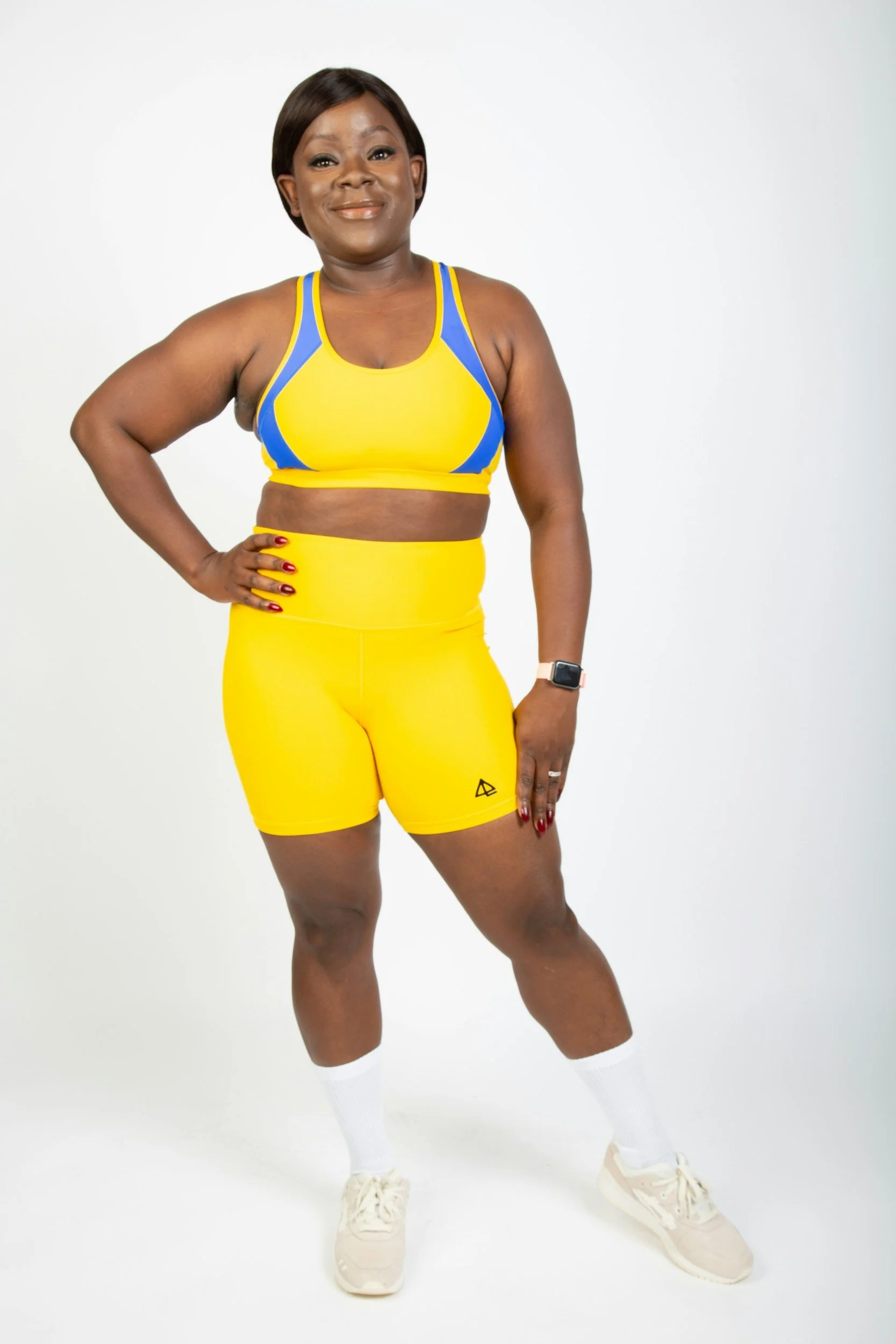
An African American athlete wearing yellow shorts and a yellow and blue sports bra. They are wearing white shoes and socks and a watch and a ring.
What is something that we all have in common? If you guessed the body, you would be correct! We all have a body that we live in on a daily basis. And the several past blog posts have highlighted a few themes: mental health, sport and performance psychology, and the mind-body connection. These themes absolutely stand on their own and are essential. What they can also do together is bridge the gap between athletes and performers, sport and performance psychology, and the body. That may sound funny to say because athletes and performers use their body constantly. And yet, when we look at sport and performance psychology we see a strong focus on the mind. As a quick reminder of what sport and performance psychology is, let's look at a quick definition. Sport and performance psychology use psychological principles to work with clients, athletes, or performers to enhance their performance. Examples of what athletes and performers learn about include, but are not limited to: focus and confidence, managing emotions and stress, coping with injuries, building mental toughness, team cohesion, goal setting, imagery, arousal, attention self-efficacy, and addressing topics like burnout and transitions in an athlete's career. (Please visit the previous blog post about sport and performance psychology by clicking here to read a more in-depth discussion if you have not read it or would like a refresher.) With all that said, sport and performance consultants can, and do, introduce progressive muscle relaxation or poses for confidence, for example, which introduces a little bit of the mind-body connection, but rarely does it dive deep into the mind-body connection. So the question becomes, what would happen if we put the body more fully back into the equation?
Why Can We Put the Body Into the Equation
If we account for interception, the mind-body connection, mindfulness, meditation, and many other concepts, does it not stand to reason that the body may have a role to play even if we are working on mental skills? The fact that progressive muscle relaxation and poses for confidence are used may mean the field is indeed more open to the idea. There are some sport and performance professionals who are engaged with the idea of utilizing brain-body techniques (Bellomo et al., 2020). So let’s explore the idea! Scientific evidence surrounding the mind-body connection suggests that the connection between the brain and the body is bidirectional, which can be seen via the oscillatory rhythms in the brain that are responsible for encoding information, establishing human conscious experiences, engaging movement, and movement driving oscillatory rhythms (Basso et al., 2021). Additionally, if we look at the mind-body connection in relation to emotions we gather further evidence. Human emotional communications originate in the body as physiological somatosensory and motor tendencies (Lauffenburger, 2020). This is just the beginning or the tip of the iceberg when it comes to looking at the connections. Just for fun let’s put one more idea into the mix we can look at psychophysiology. Psychophysiology is the study of the relationship between the mind and body via looking at how the psychological processes are reflected in physiological responses and vice-versa (Behnke et al., 2022). So now we have an entire field that studies the connection that supports the idea that maybe we do need to bring the body back into the picture when working with athletes.
Who Is Putting the Body Into the Equation
There are currently a few people who have ventured into the realm of bringing the body into their work with athletes from the sport and performance psychology perspective.
The first is the work of Patel (2020) who used it in the study and is currently using Movement Therapy for Sports (MTS®) with athletes to fill gaps in athletic training methods. Their work has roots in Dance/Movement Therapy (DMT) principles, identifies, and analyses to help athletes address physical, mental, and emotional barriers that hinder effective movement. While not specifically in the sport and performance psychology realm this work specifically does address movement as it relates to emotion, which as discussed above does make it very applicable to this discussion.
Samuel & Brom (2023) specifically in their article discussed using Somatic Experiencing® (SE™), which is a branch within body psychotherapy, with an athlete. While the paper is not a research study, it is grounded in sound research and posits what it looks like to use (SE™). Hopefully, one day someone does research this topic and builds upon the ideas in this paper.
Finally, there is the dissertation by Bow (2024) that takes the idea of using DMT and the Emotional Freedom Technique (EFT) to sport and performance consultants (SPCs) to help enhance the mental toughness of female-identifying triathletes. This work offers a suggested program to teach SPCs the skills needed to use DMT and EFT principles, techniques, and skills with their triathletes.
Currently, there is minimal work, but there are people who are asking the questions that we need to bring the body into the picture. The future is looking bright!
take action today moment:
Take the time to consider whether you ask questions or think critically about topics. These are the skills needed to help grow the different fields that we have an interest in. When we take the time to look at how other fields are working and consider how they may be applicable to ours we may find a synergy or overlap to help make both fields better.
Learn More About the Connection of Mind and Body in Athletics:
Read any of the articles mentioned in the last section of the blog post. The references are below.
Editorial: Towards a psychophysiological approach in physical activity, exercise, and sports [Article Alert]
Psychophysiological Impact of Mental Health in Athletes: A Case Review [Kind of Article Alert]
Integrating Psychophysiological Training into Sport Psychology Consulting
References
Basso, J. C., Satyal, M. K., & Rugh, R. (2021). Dance on the brain: Enhancing intra-and inter- brain synchrony. Frontiers in Human Neuroscience, 14, Article 584312. https://doi.org/10.3389/fnhum.2020.584312
Behnke, M., Buchwald, M., Bykowski, A., Kupiński, S., & Kaczmarek, L. D. (2022). Psychophysiology of positive and negative emotions, dataset of 1157 cases and 8 biosignals. Scientific Data, 9(10), 1–15. https://doi.org/10.1038/s41597-021-01117-0
Bellomo, E., Cooke, A., Gallicchio, G., Ring, C., & Hardy, J. (2020). Mind and body: Psychophysiological profiles of instructional and motivational self‐talk. Psychophysiology, 57(9), Article e13586. https://doi.org/10.1111/psyp.13586
Bow, K. (2024). Sport and Performance Enhanced by Dance/Movement Therapy and the Emotional Freedom Technique (Doctoral dissertation, University of Arizona Global Campus).
Lauffenburger, S. K. (2020). “Something more”: The unique features of dance movement therapy/psychotherapy. American Journal of Dance Therapy, 42(1), 16–32. https://doi.org/10.1007/s10465-020-09321-y
Patel, D. K. (2020). Building emotional resilience and physical stability through movement therapy for sports (MTS®): a case for applying MTS® as a tool for enhancing athletic performance among professional or trained athletes. American Journal of Dance Therapy, 42(2), 256-276.
Samuel, R. D., & Brom, D. (2023). Potential applications of somatic experiencing® in applied sport psychology. Journal of Sport Psychology in Action, 14(2), 97-109. https://doi.org/10.1080/21520704.2022.2119318