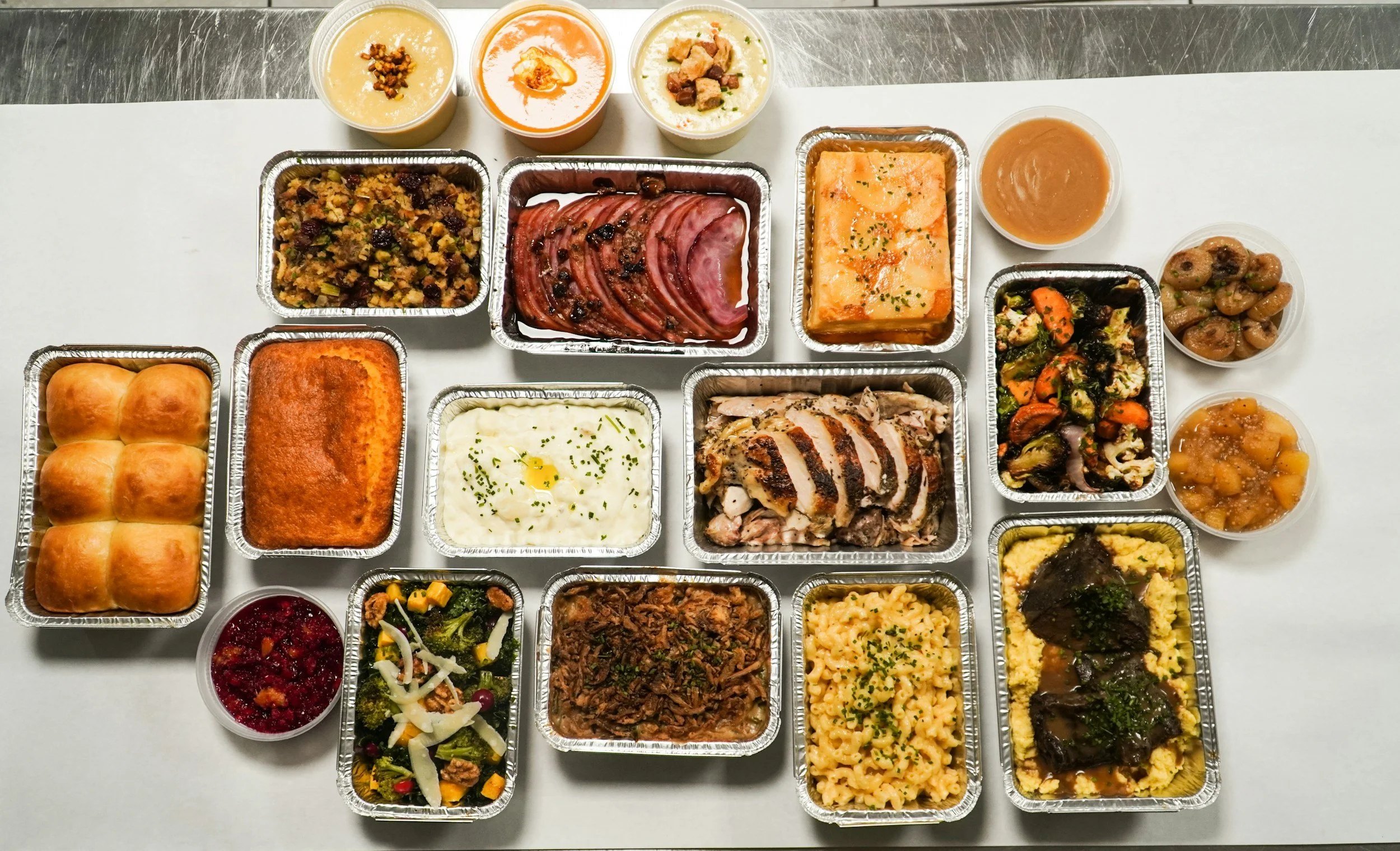
Food in aluminum dishes on white paper. Everything is resting on a gray table.
For many competitive athletes, dancers, and high performers, late autumn often coincides with the off-season or a shift into winter recovery. This may not be the case for every athlete, especially if they are into winter sports like skiing, but even winter athletes have recovery periods. Just at different times of year. After months of tracking output, managing strict training blocks, and maintaining peak physical conditioning, the holiday season arrives with a dramatic change of pace for many of us.
Tables are loaded with rich foods, family gatherings encourage sitting for hours, and the pressure to "work off" every meal starts echoing across social media feeds. We even see that happening with new year’s resolutions.
For a mind wired for high output, especially in a culture that demands high output all the time, Thanksgiving can trigger a subtle, uncomfortable threat response.
When your identity and nervous system are tied to constant physical exertion, abundant food and mandatory time off can feel unsettling. You might notice restrictive impulses kicking in, anxiety about "losing your edge," or an urge to sneak in an extra intense workout to "earn" your dinner.
It’s time to reframe the narrative.
Through a somatic and sports psychology lens, holiday nourishment isn't something to fear or earn—it is a vital, non-negotiable phase of physiological repair, nervous system down-regulation, and long-term athletic resilience.
Differing Views and Relationships with Food
When it comes to athlete performance, we often have specific ideas on the role of food and nutrition. For example, food for elite athletes is not a reward, restriction, or casual choice as nutritional intake but rather choices made as a critical element of athletic performance and ability to perform physically and mentally (Economos et al., 1993). Additionally, athletes tend to adhere to a well-balanced diet directed at their specific nutritional needs enhancing their performance, helping with efficient recovery, and reducing the risk of injuries (Amawi et al., 2024). When it comes to recreational athletes, some view nutrition through the lens of general weight loss or restriction instead of performance fueling. Either of these perspectives can potentially become challenging when it comes to Thanksgiving and similar types of food-based events. For this post, we will follow the perspective of some recreational athletes.
Viewing food through the lens of weight loss or restriction can keep the nervous system in a state of hyper-vigilance control, especially when it comes to recovery periods. For athletes who treat every meal as a metric to be earned or compensated for, your body stays locked in a sympathetic (fight-or-flight) baseline. High cortisol levels persist, digestion suffers, and your tissues remain braced.
True recovery requires a shift from control to somatic trust:
Under-fueling during rest blocks signals biological scarcity to the brain, which suppresses thyroid function, disrupts hormonal health, and delays deep muscle repair (Wang et al., 2024; Wasserfurth et al., 2020).
Abundant, varied nourishment signals physiological safety, allowing the endocrine system to rebalance, glycogen stores to fully saturate, and nervous system reserves to rebuild for the next competitive block (Naderi et al., 2025; Schwietert et al., 2026).
3 Somatic Shifts for the Holiday Table
This Thanksgiving, use these body-led strategies to navigate holiday meals without performance anxiety, guilt, or rigid control:
1. Shift from "Caloric Accounting" to "Sensory Nourishment"
When anxiety around food arises, it usually pulls you up into analytical, counting thoughts in your head. Bring your awareness back down into your senses.
The Practice: Before taking your first bite, pause for five seconds. Smell the food, notice the colors on your plate, and feel the weight of your feet on the floor. Eat the first three bites slowly, paying attention to texture and taste. Engaging your senses shifts your system from anxious analysis into parasympathetic digestion.
2. Differentiate "Physical Hunger" from "Performance Fear"
Athletes are hyper-aware of bodily signals, yet holiday stress can muddy interoception (your ability to sense internal bodily states).
The Practice: When you feel an impulse to restrict or over-control your plate, gently ask yourself: "Is this thought coming from my body's actual needs, or is it coming from a fear of losing my fitness?" Naming the fear helps put some distance between your busy analytical mind from your immediate physical needs.
3. Reframe Rest as "Active Tissue Repair"
Sitting on the couch or spending an entire day off can trigger a "rest guilt" response in some athletes, making you feel restless or lazy.
The Practice: Reframe quiet days. Cellular repair, tendon remodeling, and neural consolidation happen exclusively during low-output, well-fueled windows. Rest is not the absence of training; it is the phase where adaptation actually takes place (Li et al., 2024; Sousa et al., 2024). We know this in our heads and yet oftentimes fail to actually let it sink in about how important rest is when it comes allowing us to perform at our best.
You cannot build a high-performing house on an exhausted foundation.
The most resilient athletes aren't those who maintain 100% intensity 365 days a year; they are the ones who know how to lean fully into recovery when the season or time offers the opportunity.
This Thanksgiving, treat your holiday meal as an act of somatic investment. Give your body permission to enjoy the food (not indulge and overeat), rest the engine, and soak up the safety of the off-season—so when it’s time to step back into the arena, you return fully fueled, regulated, and ready to perform.
take action today moment:
Do a belief check. What do you believe about food and nutrition? What do you believe about rest? These are two important questions that require all of us to acknowledge our beliefs and how they connect to our actions. We may know how important proper nutrition is as well as rest, but do we actually take action with this knowledge? Be honest with yourself!
Learn More About Athletes and Holidays:
How to Support Ambitious Athletes During the Holidays
References
Amawi, A., AlKasasbeh, W., Jaradat, M., Almasri, A., Alobaidi, S., Hammad, A. A., Bishtawi, T., Fataftah, B., Turk, N., Saoud, H. A., Jarrar, A., & Ghazzawi, H. (2024). Athletes' nutritional demands: A narrative review of nutritional requirements. Frontiers in Nutrition, 10, 1331854. https://doi.org/10.3389/fnut.2023.1331854
Economos, C. D., Bortz, S. S., & Nelson, M. E. (1993). Nutritional practices of elite athletes. Practical recommendations. Sports Medicine (Auckland, N.Z.), 16(6), 381–399. https://doi.org/10.2165/00007256-199316060-00004
Li, S., Kempe, M., Brink, M., & Lemmink, K. (2024). Effectiveness of recovery strategies after training and competition in endurance athletes: An umbrella review. Sports Medicine - open, 10(1), 55. https://doi.org/10.1186/s40798-024-00724-6
Naderi, A., Rothschild, J. A., Santos, H. O., Hamidvand, A., Koozehchian, M. S., Ghazzagh, A., Berjisian, E., & Podlogar, T. (2025). Nutritional strategies to improve post-exercise recovery and subsequent exercise performance: A narrative review. Sports Medicine (Auckland, N.Z.), 55(7), 1559–1577. https://doi.org/10.1007/s40279-025-02213-6
Schwietert, A. K. K., Knap, K., Tonin, G., Kozjek, N. R., & Gleeson, M. (2026). Energy, carbohydrates and fats in clinical sports nutrition. Clinical Nutrition ESPEN, 71, 102900. https://doi.org/10.1016/j.clnesp.2025.102900
Sousa, C. A., Zourdos, M. C., Storey, A. G., & Helms, E. R. (2024). The importance of recovery in resistance training microcycle construction. Journal of Human Kinetics, 91(Spec Issue), 205–223. https://doi.org/10.5114/jhk/186659
Wang, L., Meng, Q., & Su, C. H. (2024). From food supplements to functional foods: Emerging perspectives on post-exercise recovery nutrition. Nutrients, 16(23), 4081. https://doi.org/10.3390/nu16234081
Wasserfurth, P., Palmowski, J., Hahn, A., & Krüger, K. (2020). Reasons for and consequences of low energy availability in female and male athletes: Social environment, adaptations, and prevention. Sports Medicine - open, 6(1), 44. https://doi.org/10.1186/s40798-020-00275-6