
A Thanksgiving meal on wooden tabel. There is turkey, rolls, mashed potatoes, stuffing, and a small pumpkin for decoration.
Many of us have experienced the heavy, slump-on-the-couch feeling after a large holiday meal. We finish dinner, clear the table, and suddenly feel as though an anchor has been tied to your limbs. Often, we brush this off with a joke about turkey, carb overload, or the dreaded "food coma." But what if we used this experience to explore a different kind of topic as it relates to the body and psychology.
True parasympathetic rest versus function freeze.
Yield versus collapse.
Understanding the difference between each of two pairs can be helpful when it comes to leaving the holiday season feeling genuinely restored rather than drained, numb, and detached. We will begin with looking at yield versus collapse briefly before we talk about the other pair.
Yield vs. Collapse
In the world of somatic movement and body mechanics, Bonnie Bainbridge Cohen (2026) introduced Body-Mind Centering® (BMC). This somatic practice integrates movement, touch, voice, and mind to enter into an exploration of how consciousness is expressed in the body. This approach blends science and direct experience to re-education psychological patterns. Within this approach Cohen (2026b) differentiates between yielding and collapsing. Yielding is an active, grounded engagement with gravity and support, while collapsing is more of a passive loss of tone, connection, and structural integrity. To help with picturing the difference, think about how we can come home from work or school and just collapse onto the coach and not want to move. That is a collapse. A yield on the other hand might look more like settling on a comfy chair to read a book.
While we don’t dive too much into each of these there is one big difference that is important to point out here. When we yield we also create the necessary foundation to be able to move with efficiency and minimal effort. However, when we collapse we have lost our center orientation which makes it hard for us to keep good posture, increases our fatigue, and can lead to an inability to transition safely into movement. What we ideally want to find is yield rather than a collapse where we are active in our rest rather than disconnected.
Parasympathetic Rest vs. Functional Freeze:
Both states may feel look or feel like low-energy and quiet on the outside, but they represent two entirely different states within your nervous system:
True Rest (Ventral Vagal State): This is your body's natural "rest-and-digest" mode. Your nervous system feels safe, relaxed, and connected. Your muscles soften, your breathing is easy, and while you might feel sleepy, there is an underlying sense of warmth, contentment, and comfort in your body.
Functional Freeze (Dorsal Vagal State): This is a biological defense mechanism. When your nervous system experiences sensory overload, social fatigue, or boundary stress that feels too overwhelming to fight or run from, it pulls the emergency brake. Your body numbs out to protect you.
These states are pulled from Porges (2022) Polyvagal Theory which posits that our autonomic nervous system developed a repertoire of adaptive response patterns described as three primary states—supporting social engagement, mobilization, and immobilization—which shift dynamically based on perceived safety. Past posts have talked about this theory in detail and in different ways. Please feel free to explore the blog to learn more or visit the Polyvagal Institute website to learn more. For our post today the point here is that we experience true rest, you feel recharging peace as we have entered the engagement state according to the theory. In functional freeze, you feel heavy paralysis, brain fog, and disconnection because it is a nervous system state focused on immobilization.
This is where we will take a moment to connect the parasympathetic rest to the yield experience. Yielding gives the image or the bodily experience of what parasympathetic rest can feel like while collapsing is similar to the functional freeze.
How Holiday Overload Triggers "Freeze"
Holiday gatherings are a perfect storm for nervous system overload:
Sensory Overload: Multiple overlapping conversations, television noise, clinking dishes, unfamiliar smells, and bright lighting keep your brain scanning for input.
Relational Vigilance: Managing family expectations, tracking social cues, or avoiding sensitive conversational topics requires constant subconscious effort.
Physical Boundary Shifts: Sitting close to others for hours, changing your normal movement routines, and eating different foods can disrupt your body's baseline anchors.
When the input exceeds your system's capacity to process it, your nervous system can step into a freeze response to protect you from total exhaustion. You aren't just digesting food; your nervous system is trying to digest overwhelming stimulation.
Spotting the Signals in Your Body
To determine which state you are in, pause and perform a quick somatic check-in:
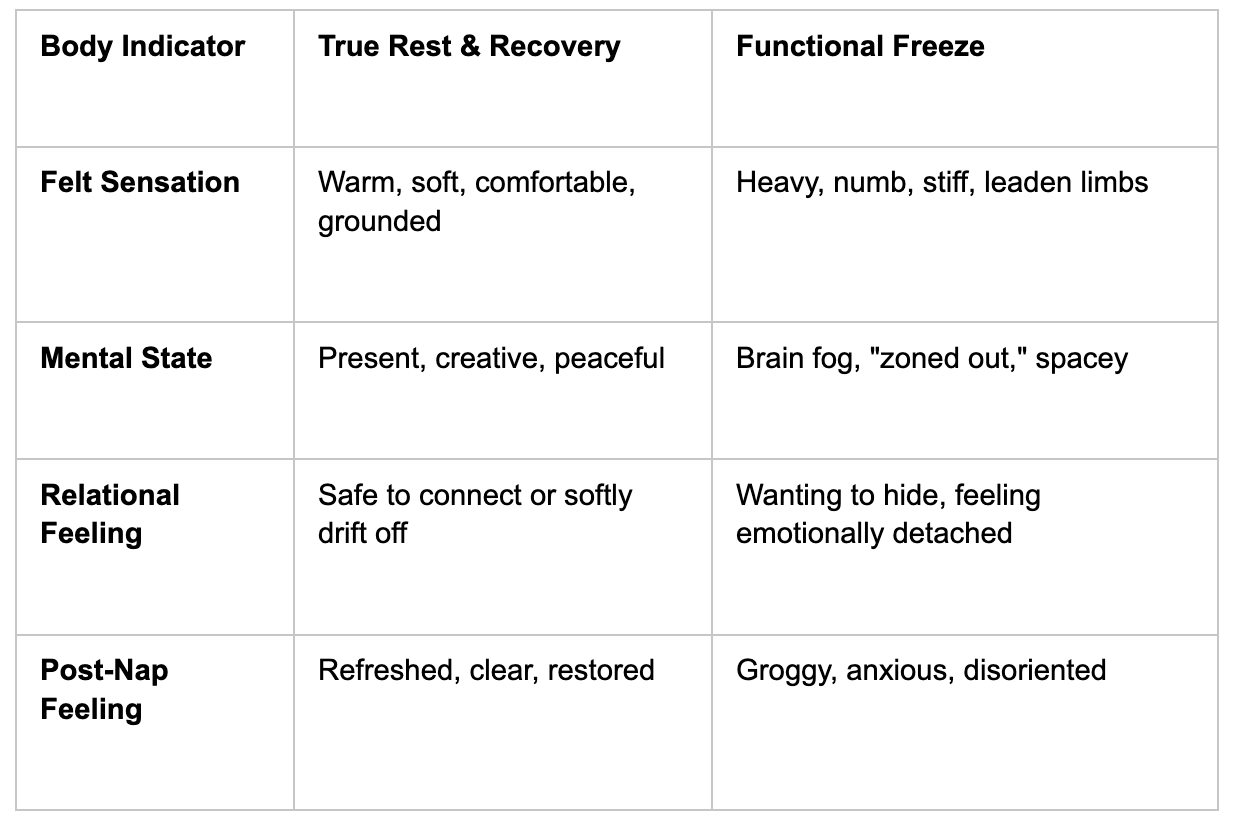
A table breaking down the differences between rest and recovery and the freeze response.
3 Somatic Shifts to Move from Freeze Back into Connection
If you realize you’ve slipped into a functional freeze on the couch, don't force yourself into high-energy socializing. Use these gentle, body-based micro-movements to bring your system back to baseline safety:
1. Re-Orient Through the Senses
Freeze pulls your consciousness inward into a foggy haze. Orientation brings you back into the present moment.
The Practice: Keep your body still, but slowly turn your head to look around the room. Find 3 objects that feel visually soothing (a flickering candle, the texture of a throw blanket, a warm color). Let your eyes rest on each object for 5 seconds.
2. Introduce Micro-Movement to Your Extremities
When frozen, trying to go for a vigorous walk can feel impossible. Start small at the edges of your body.
The Practice: Wiggle your toes inside your socks. Gently press your heels into the floor. Roll your wrists or make slow, tiny circles with your ankles. These micro-movements tell your motor cortex that movement is safe again without spiking adrenaline.
3. Use Tactile Warmth for Self-Soothing
Coldness or numbness often accompanies a dorsal vagal freeze. Warmth acts as a direct somatic signal of safety.
The Practice: Wrap a heavy blanket snugly around your shoulders, hold a warm mug of tea with both hands, or place one hand firmly over your heart and the other over your belly. Feel the physical rise and fall of your chest beneath your hands.
This holiday season, give yourself permission to listen to the deeper wisdom of your physiology.
If your body needs true rest and it is a safe place to do so, honor it by sinking into the couch with gratitude. But if you recognize that your system is numbing out due to overload, step away into a quiet room, use simple somatic tools to re-anchor, and give your nervous system the quiet boundary it is asking for.
Real restoration happens when we stop forcing performance and start honoring our body's need for felt safety.
take action today moment:
Begin to bring awareness to what yield and true rest feel like versus functional freeze and collapse feel like in your body. The key here is to remember not to judge yourself no matter what state you find yourself in. But, by getting to know these states you can make more informed choices about what kind of rest you would like to engage in.
Learn More About Polyvagal Theory:
18 Polyvagal Theory & How to Use the Exercises in Therapy
References
Cohen, B. B. (2026a). Body-Mind Centering®. https://bonniebainbridgecohen.com/pages/body-mind-centering
Cohen, B. B. (2026b). Yield versus collapse. https://bonniebainbridgecohen.com/blogs/bonnie/yield-versus-collapse
Porges, S. W. (2022). Polyvagal theory: A science of safety. Frontiers in Integrative Neuroscience, 16, 871227. https://doi.org/10.3389/fnint.2022.871227