Spring is Here! What About Our Mental Health?
As of Friday, Mar 20, 2026, 8:46 AM MDT, we are officially in spring. Depending on where you are in the Northern Hemisphere, the time may be different. That time is the spring equinox, veteran equinox, or what is also known as the First Point of Aries. Spring brings with it budding flowers, the fresh green of new plant life, the birth of baby animals, and days filled with more light. It’s a beautiful time of year.
With the changing of the seasons, we may need to stop and consider our connection with nature, as there is an essential link between the two. Research is littered with evidence for the important link between mental health and nature. For example, natural experiences impact human cognitive function in memory, attention, concentration, impulse control, and mood (Bratman et al., 2012; Bratman et al., 2019). Even low levels of nature within neighborhoods can be connected to better mental health (Cox et al., 2017). This is just the tip of the iceberg within the research. It is clear that nature is good for our mental health.
Now we are free to look at how the changing of the seasons may also play a role in our mental health. There are some topics that are talked about, like Seasonal Affective Disorder (Magnusson & Boivin, 2003), wherein reduced sunlight lowers serotonin and increases melatonin leading to low energy, or the increase in isolation during the winter months increasing the feelings of loneliness. There are some other topics that are worth noting in addition to the above. For example, what about the immune system and how seasons impact the immune system and mental health? Immune dysregulation may have a role in psychiatric disorders (Modzelewski et al., 2025). Additionally, what about the role of circadian rhythms? Circadian rhythms potentially mediate seasonal effects given the role that light plays in our circadian rhythms and if our rhythms are not able to accommodate seasonal changes the risk for mood and behavior issues increases (Zhang & Volkow, 2023). Now enough with research for the moment!
While nature is essential for our mental health we also must consider the nuances because of how tight and essential the connection is between us and nature. We spend so much time inside, engaging with technology, or a myriad of activities that take us away from our connection with nature so we have potentially lost our opportunity to notice how nuanced these connections are. So maybe spring is a good time to give ourselves the gift of finding our connection with nature in service of our mental health.
Here are a few suggestions for activities that you may want to consider that allow you get outside and enjoy nature:
Hiking or nature walks
Morning walks
Gardening
Outdoor yoga or meditation
Picnicking
Photography
Seasonal eating
Outdoor journaling or reading
Volunteering for nature clean-ups
These are just a few suggestions. There are many other activities that you could do!
One more quick visit to the research. There exists a positive correlation between summer and psychological wellbeing, winter and sleep duration, and for spring there is also positive correlation with psychological wellbeing (Kanwal et al., 2023). So while you welcome Spring this year consider how you can enhance your mental health through some vitamin N.
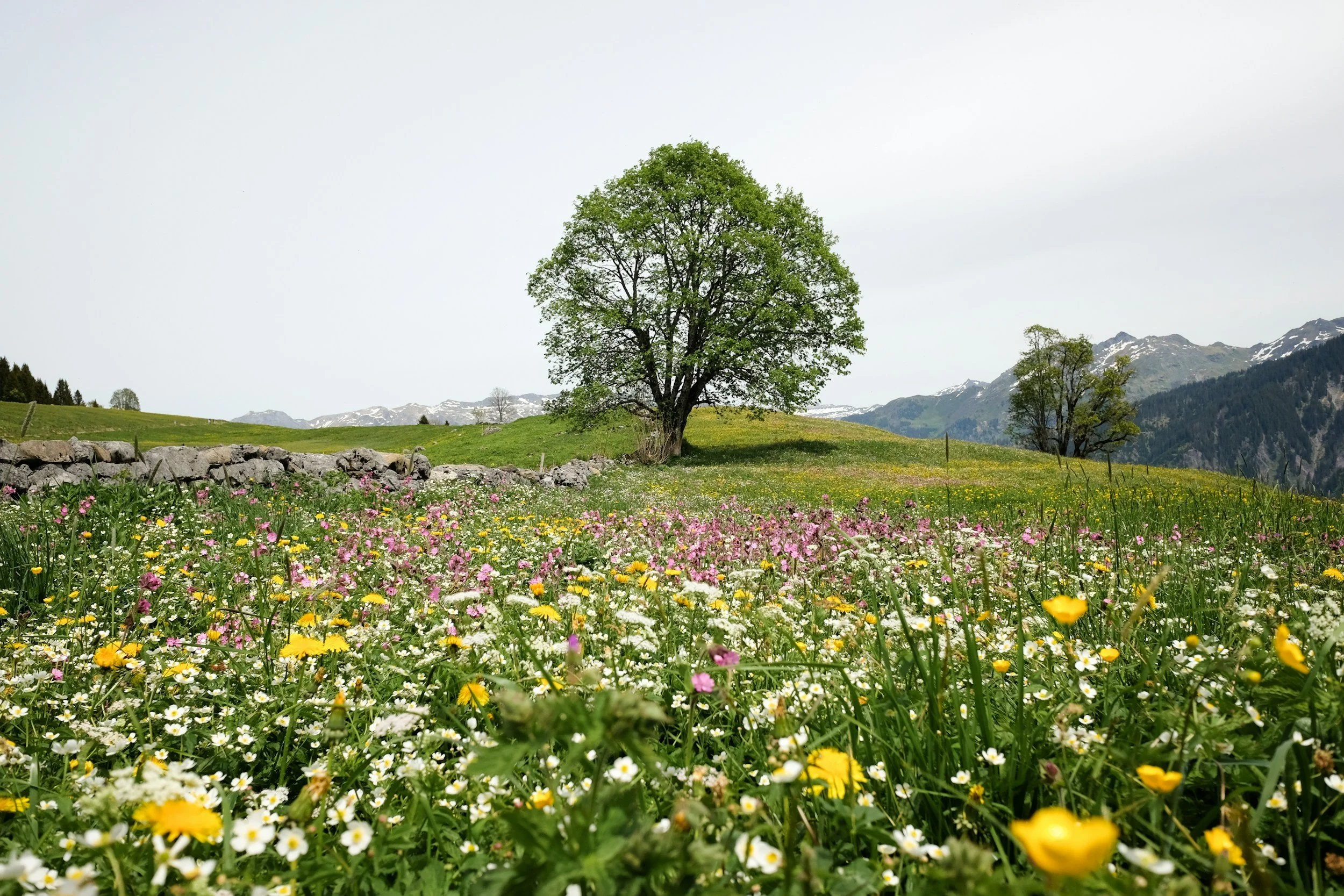
A spring image with wild flowers in a field, two trees in the background, and mountains in the back center on the right. The sky is light blue.
take action today moment:
Nature is powerful in many senses of the word. When it comes to your mental health, consider how you are engaging with the change of season. Are you slowing down and engaging with nature and noticing how nature is impacting your life or not? Or are you focusing on many other things in your life and missing the opportunity? Yes, we are all busy. There are many demands on our plates. Remember that when you take care of yourself you can be more present for others in our lives.
References
Bratman, G. N., Anderson, C. B., Berman, M. G., Cochran, B., De Vries, S., Flanders, J., ... & Daily, G. C. (2019). Nature and mental health: An ecosystem service perspective. Science Advances, 5(7), eaax0903. doiI: 10.1126/sciadv.aax0903
Bratman, G. N., Hamilton, J. P., & Daily, G. C. (2012). The impacts of nature experience on human cognitive function and mental health. Annals of the New York Academy of Sciences, 1249(1), 118-136. doi: 10.1111/j.1749-6632.2011.06400.x
Cox, D. T., Shanahan, D. F., Hudson, H. L., Plummer, K. E., Siriwardena, G. M., Fuller, R. A., ... & Gaston, K. J. (2017). Doses of neighborhood nature: The benefits for mental health of living with nature. AIBS Bulletin, 67(2), 147-155.
Kanwal, S., Javaid, A., & Bibi, S. (2023). Effect of seasonal changes on psychological well-being of women. International Research Journal of Social Sciences and Humanities, 2(2), 175-194. https://irjssh.com/index.php/irjssh/article/view/54
Magnusson, A., & Boivin, D. (2003). Seasonal affective disorder: an overview. Chronobiology International, 20(2), 189-207. https://doi.org/10.1081/CBI-120019310
Modzelewski, S., Naumowicz, M., Suprunowicz, M., Oracz, A. J., & Waszkiewicz, N. (2025). The impact of seasonality on mental health disorders: A narrative review and extension of the immunoseasonal theory. Journal of Clinical Medicine, 14(4), 1119. https://doi.org/10.3390/jcm14041119
Zhang, R., & Volkow, N. D. (2023). Seasonality of brain function: Role in psychiatric disorders. Translational Psychiatry, 13(1), 65. https://doi.org/10.1038/s41398-023-02365-x