The Bare Branch: Finding Strength in Vulnerability After the Shedding
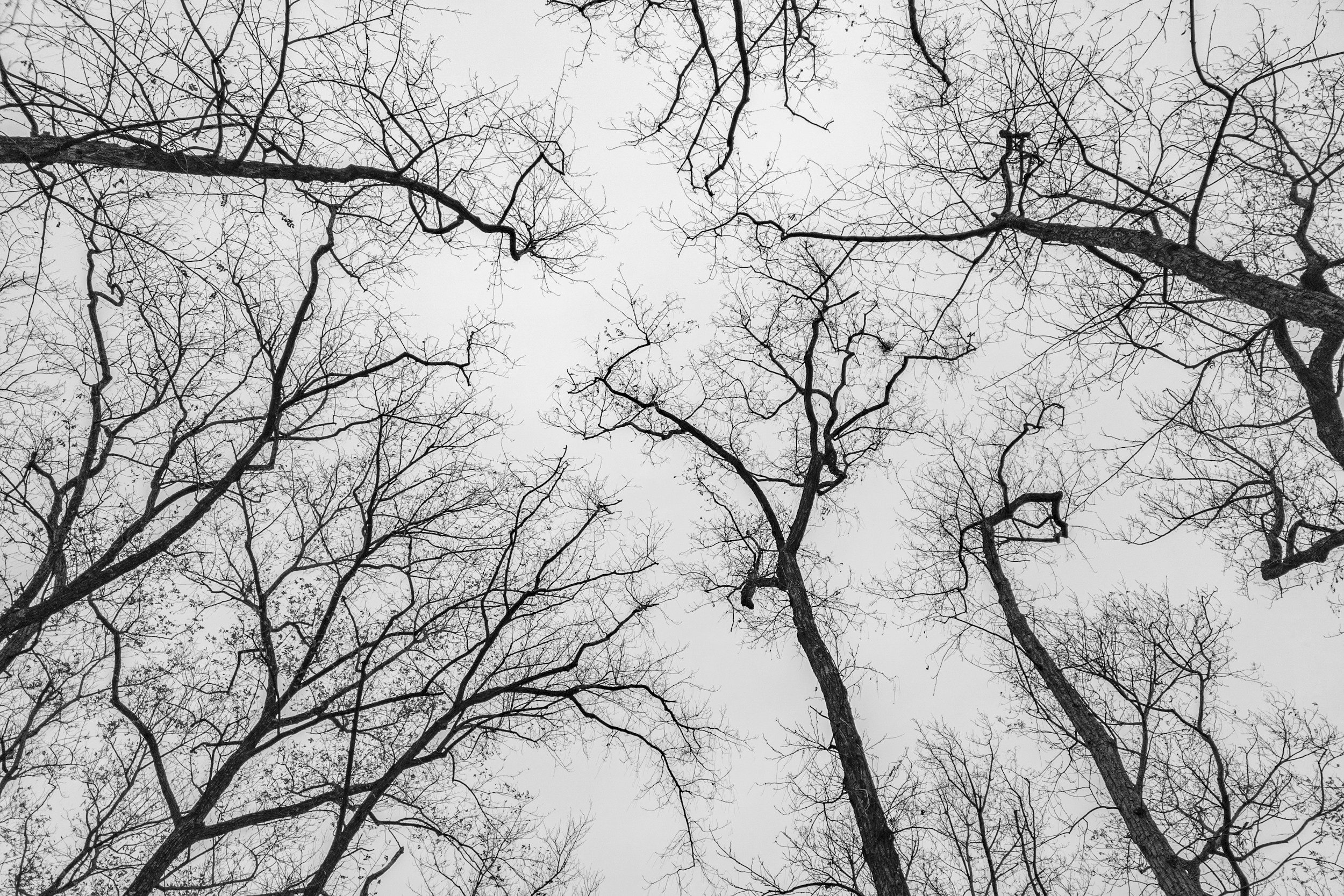
Trees with no leaves against a gray sky.
Thus far this month we have journeyed through the full color palette of fall. We found small spots of light in the bright yellows, learned to navigate life shifts with orange, discovered the strength of setting strong boundaries in deep red, and practiced the quiet art of letting go with brown.
And now, the leaves are gone. The tree is bare.
What remains of the trees are exposed and quiet. Standing under a canopy of bare branches can feel unsettling. Without the vibrant foliage to soften the skyline, every curve, bend, and scar on the tree trunks are completely visible. The trees are exposed.
The phase right after a major transition—after we’ve set the boundary, walked away from the old role, retired from the sport, or dropped an outdated habit—often feels like standing bare against a cold sky. It is vulnerable, quiet, and deeply uncomfortable.
Yet, the bare branch is not a sign of defeat or weakness. It is the moment a tree relies entirely on its core structure.
The Fear of Being "Uncovered" (Identity Exposure)
When we strip away our busyness, our performative roles, our people-pleasing, and the external validation we wear like leaves, we are left face-to-face with ourselves.
For high achievers, athletes, and busy professionals, this "bare branch" season often triggers an internal alarm. The mind starts to question:
"Who am I if I’m not constantly producing?"
"What if people see me without my achievements and realize I’m not enough?"
"Why do I feel so exposed and anxious when nothing is technically wrong?"
From a somatic perspective, the brain views sudden emptiness as a loss of structure. For years, protective habits—overworking, staying quiet, or overextending—were shelter. Removing them leaves the self and nervous system feeling unsheltered. The bodily sensations we may experience, like physical tightness in the throat or the hollow feeling in one’s stomach isn't a sign that a mistake has been made by letting go; it is the body adjusting to being seen without its “leaves.”
Just a quick deeper neuroscience dive to look at the default mode network (DMN). The DMN is described as an internal model of internal bodily states (Kim et al., 2025) and is composed of the medial prefrontal cortex (MPFC) and posterior cingulate cortex (PCC), inferior parietal, and medial temporal regions (Davey & Harrison, 2018). When it comes to the DMN it works to coordinate network integration to impact our body’s response to events, thereby encouraging adaptive and flexible behavior in more complex environments and from this process that our sense of self emerges (Davey & Harrison, 2018). This dive was meant to highlight what parts of the brain may be at play
Why the Bare Season is Biologically Essential
A tree doesn't stand bare because it failed to keep its leaves; it stands bare because carrying foliage through a winter storm would destroy it.
If a tree kept its full canopy of leaves during heavy winter snow and freezing winds, the added surface area would catch the ice, causing the heavy branches to snap under the weight. By dropping the leaves, the tree minimizes its surface area, allowing winter winds to pass right through its branches without breaking them. Smart adaptation!
Your bare season may be offering something similar for your mental health:
It reduces your operational friction so you don't break under seasonal stress.
It forces you to stop relying on external decoration for your worth.
It shifts your energy from outward display to inward structural integrity.
3 Somatic Practices for the "Bare Branch" Season
When you feel exposed and uncomfortable in the quiet that follows a major life shedding, use these body-based tools to anchor into your core strength:
1. Track Your "Spine as the Trunk"
When we feel vulnerable, we tend to either collapse inward or rigidly brace our muscles. Practice finding your structural baseline:
Sit or stand tall, sensing the length of your spine.
Imagine your spine as the solid trunk of the tree—strong, rooted, and steady. Image roots reaching towards the Earth providing rounding as the crown of your head reaches towards the sky.
Allow your arms, shoulders, and jaw (the outer branches) to soften completely around that steady center. You can be soft on the outside because you are strong on the inside.
2. Practice "Wind-Enliving-the-Branches" Breathing
Instead of fighting uncomfortable emotions like uncertainty or grief, visualize them as the winter wind enlightening bare branches with information from the air.
Inhale slowly through your nose, imagining space opening up in your chest.
Exhale long and slow through your mouth, reminding your nervous system: "There is nothing to catch the storm here. The wind enlightens my journey without taking me down."
3. Establish a "Core-Only" Daily Capacity
In a bare season, your energy reserves are meant for conservation, not peak performance. Identify 2–3 non-negotiable daily anchors (e.g., eating a warm meal, taking 10 minutes to stretch, sleeping 8 hours). Anything beyond those basics is extra. Give yourself permission to live simply while your roots integrate the change.
It takes immense courage to let the leaves fall and stand in the quiet truth of who you are without the noise, titles, or hustle.
Remember: winter bareness is never permanent. Beneath the rough bark, protected deep within the core of the tree, life is actively resting and preparing for the next iteration of spring. You aren't empty—you are simply conserved, strong, and ready for root-level growth.
take action today moment:
Give one of the somatic practices a try. Remember that when we are laid bare and vulnerable, it is a time to explore, learn about ourselves, and find our true center within ourselves without relying on external validation. During this time and exploration, be mindful of surrounding yourself with support from people who you trust so that you are not vulnerable around people who will take the opportunity to tear you down.
Learn More About Vulnerability and Self:
Loss of Identity: How to Reconnect With Your True Self
The Identity Crisis So Many of Us Face
References
Davey, C. G., & Harrison, B. J. (2018). The brain's center of gravity: How the default mode network helps us to understand the self. World Psychiatry: Official Journal of the World Psychiatric Association (WPA), 17(3), 278–279.https://doi.org/10.1002/wps.20553
Kim, H. J., Lee, J. I., & Woo, C. W. (2025). Embodying the default mode network: Self-related processing from an embodied perspective. Current Opinion in Behavioral Sciences, 66, 101607. https://doi.org/10.1016/j.cobeha.2025.101607