Fall Leaf Inspiration: Red - The Strength of Setting Clear Boundaries
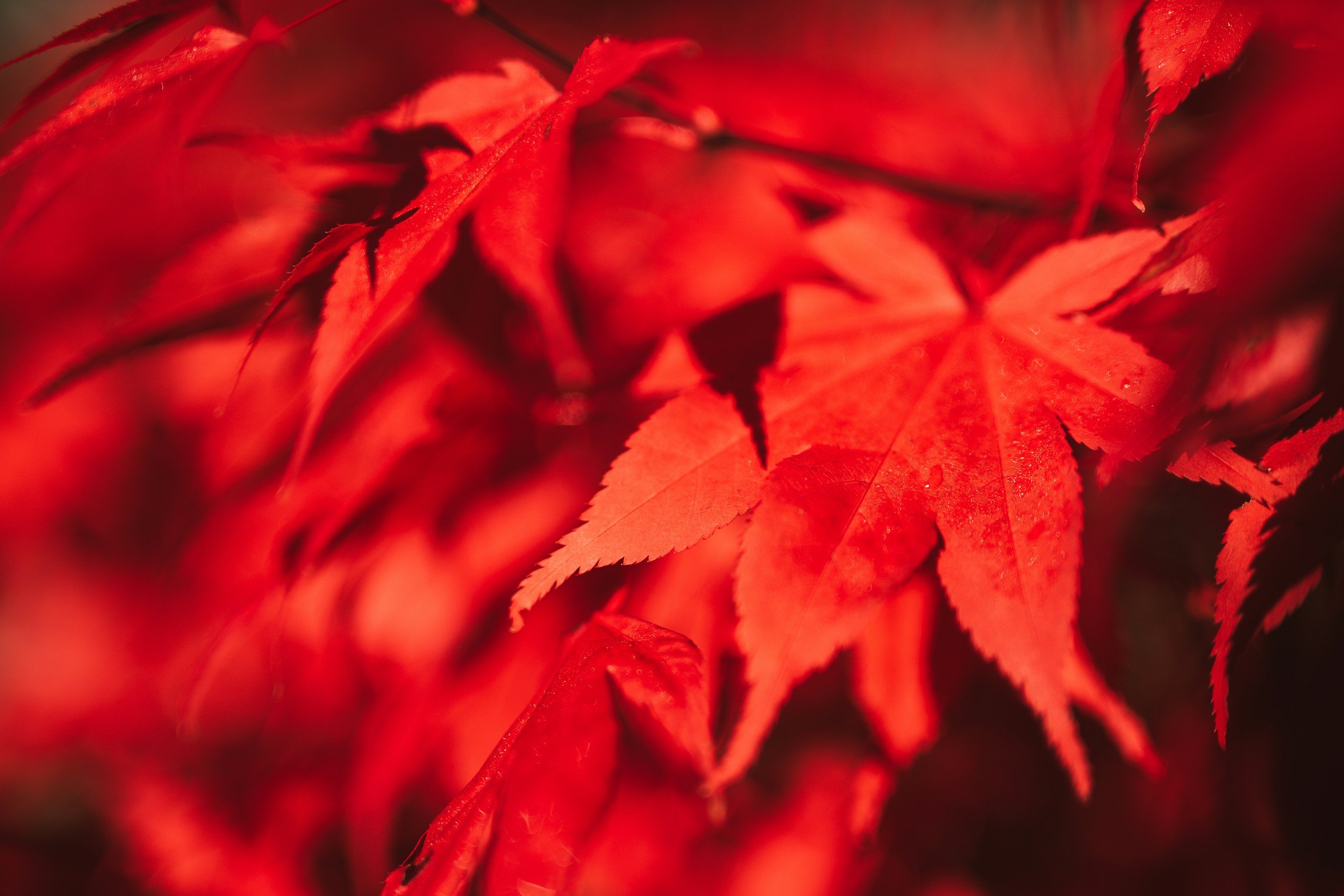
Red leaves. Two leaves are in focus while the rest are blurred.
Yellow. Orange. And, now we finally reach red! Of all the colors that paint the autumn landscape, deep crimson red may be one the most striking. It stands out bold, clear, and uncompromising against the backdrop of the changing forest.
In nature, red leaves are a sign of intense, protective energy. Right before a tree sheds its foliage, it produces anthocyanins—the vivid red pigments—to shield its branches from sun damage and protect its core nutrients as cold weather sets in (Feild et al., 2001). The deep red leaf is not a sign of retreat; it is a masterclass in self-preservation and strength as the tree begins the process of pulling its resources into itself to prepare for winter.
In life, we often struggle to protect our core energy the way nature does. We say "yes" when our bodies are screaming "no." We overcommit to work, family, or social obligations out of guilt or embedded understanding of how important it is to help people, leaving ourselves depleted, resentment-filled, and exhausted. Whether we overcommitted because we felt guilty or because we care so deeply about people, we must be mindful of ourselves and our choices so that we make choices from a more embodied place. This is where boundaries can be helpful.
Setting strong boundaries isn't mean, selfish, or aggressive. Like the crimson leaves of fall, setting boundaries is a vital act of strength that protects your time, mental health, and nervous system from being completely drained. This post will just be lightly touching on boundaries as either a reminder if you read the more in-depth series in previous months or it will be a good introduction to boundaries.
The Somatic Cost of Not Saying "No"
When we consistently override your personal limits to keep others comfortable, our body and mind pays the bill.
From a somatic perspective, chronically overcommitting keeps your autonomic nervous system trapped in a low-grade "fight-or-flight" state. That means that the hypothalamic–pituitary–adrenal (HPA) axis is constantly left on with cortisol constantly being released to circulate around the body (Marin et al., 2011). Research has already demonstrated how chronic stress can cause structural changes in the brain impacting cognition and stress and also impacts other vital organs like the heart and liver causing unfavorable health conditions (Noushad et al., 2021). Signs that we might notice physically include, but are not limited to:
A persistent tightness in your jaw or stomach whenever a new request arrives.
Feeling instant exhaustion or dread when your phone rings.
Shallow breathing and physical restlessness during conversations where you feel overstepped.
Our bodies use these types of sensations to alert us that a line has been crossed and your nervous system is responding accordingly. When we ignore these physical signals and force a "yes," we teach ourselves that other people's comfort is more important than our own safety and wellbeing. While other people’s comfort and wellbeing are important, the best way to support others is by showing up fully for ourselves so we can be fully present for others when needed. Protecting our energy is also essential for long-term emotional resilience.
How to Set Clear, Kind Limits
Many people avoid setting boundaries because they mistake a boundary for a conflict or for being closed off and uncaring. But a boundary is simply a clear statement of what you can and cannot offer. You don't need to be harsh to be firm; clarity is the ultimate form of kindness.
Here are practical, gentle ways to set strong limits with work, friends, and family:
1. Boundaries at Work
Protecting your off-hours allows you to bring your best energy to your actual working hours.
The Overloaded Schedule: "I want to give this project the attention it deserves. Given my current workload, I can’t take this on right now without delaying [Project X]. Which one should I prioritize?"
Off-Hours Communication: "I’ve logged off for the evening to recharge and be with my family/friends/self, but I will review this first thing tomorrow morning at 9:00 AM."
2. Boundaries with Friends
The best friendships thrive when both people feel safe honoring their actual capacity.
Low Emotional/Social Energy: "I love spending time with you, and my energy is really low this week. I need a quiet night in, but let’s reschedule for next weekend when I can be fully present."
Holding Space for Venting: "I care about what you’re going through and want to support you. I don't have the mental bandwidth for a heavy conversation at this moment. Can we catch up on Saturday so I can be there to support you with all my attention?"
3. Boundaries with Family
Family dynamics often trigger the strongest guilt, making somatic grounding (keeping your posture open and breathing steady) essential when speaking up.
Protecting Holiday/Weekend Time: "We’re so excited to see everyone, and we’ll only be able to stay for dinner this time so we can make sure the kids stay on their sleep schedule."
Unsolicited Advice or Intrusive Questions: "I know you’re asking out of love, and I’m comfortable with the decision I’ve made and would prefer not to talk about it today."
Setting boundaries is a practice, not a one-time event. The first few times we say "no," our heart might race or guilt might bubble up—and that is completely normal. Our nervous systems are simply adjusting to a new way of protecting itself.
This fall, let the deep red leaves remind you that protecting your energy is a sign of health, not weakness. Standing firm in your limits isn't pushing the world away; it's ensuring you have enough strength left to show up for yourself, the things that truly matter, and those that you love.
take action today moment:
This fall takes some time to understand where you are on your boundary journey. What areas in your life do you need to shore up your boundaries? What areas in your life do you need to enact boundaries? Remember boundaries are a sign of health, not weakness.
Learn More About Boundaries:
How is Life Tree(ting) You?: Trust, Safety, and Respect - The Importance of Boundaries
What are boundaries? A professional counselor explains
References
Feild, T. S., Lee, D. W., & Holbrook, N. M. (2001). Why leaves turn red in autumn. The role of anthocyanins in senescing leaves of red-osier dogwood. Plant Physiology, 127(2), 566–574.
Marin, M. F., Lord, C., Andrews, J., Juster, R. P., Sindi, S., Arsenault-Lapierre, G., ... & Lupien, S. J. (2011). Chronic stress, cognitive functioning and mental health. Neurobiology of Learning and Memory, 96(4), 583-595.
Noushad, S., Ahmed, S., Ansari, B., Mustafa, U. H., Saleem, Y., & Hazrat, H. (2021). Physiological biomarkers of chronic stress: A systematic review. International Journal of Health Sciences, 15(5), 46-59.