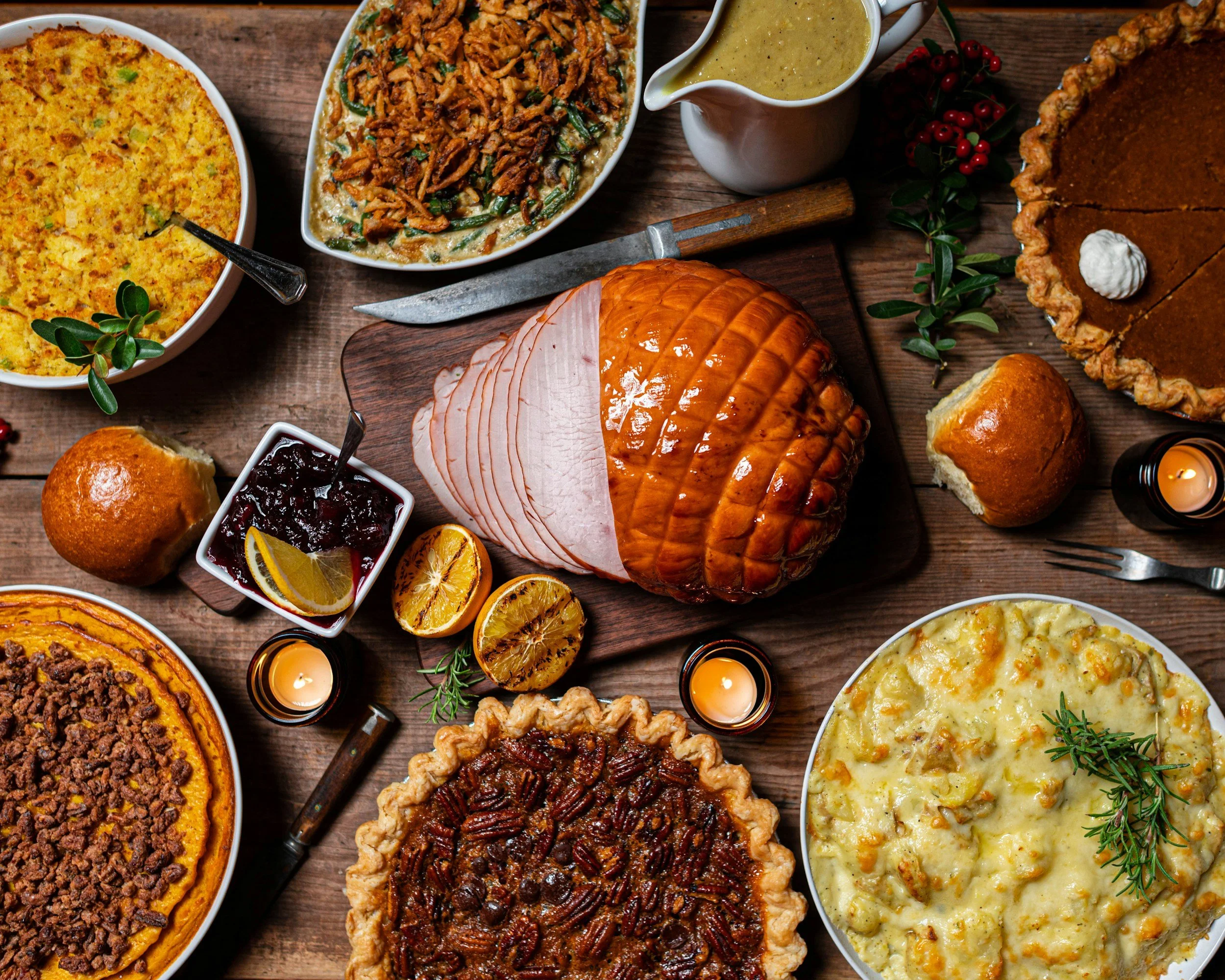
A table full of food. There is ham in the center surrounded by three pies, gravy, sauces, and three other dinner dishes. There are two pieces of bread on either side of the gam and a carving knife above the ham.
Last month we spent the month exploring different topics via Halloween themed posts. Hopefully, everyone found them interesting and maybe even a little fun. The month ended by talking about how to prepare for the holiday season. It is this threat that we will continue to explore this month as the holidays can bring up different feelings, reactions, and experiences. Let’s begin by bringing back a topic that has been an undercurrent in many subsequent blog posts.
Thanksgiving is often advertised as a season of warm gatherings, shared laughter, and peaceful reflection. It is a nice picture! But the reality may be different for many of us. Sitting down at a crowded holiday table may instead feel less like a cozy celebration and more like navigating a physiological minefield.
Long-held family dynamics, unsolicited comments about your career path, political debates, and sensory overload (overlapping voices, clinking silverware, bright lights) can instantly flip your biological alarm system. Yep! It can! Before you’ve even finished your first course, you might notice your jaw clenching, your breathing becoming shallow, or a sudden, overwhelming urge to retreat into another room. These are all body sensations that you need to pay attention to!
These reactions aren't character flaws—they are implicit nervous system memories. Let’s break this concept down a little bit. Implicit memories are (1) automatic, (2) non-effortful, (3) incidental, and (4) fast (Rovee-Collier et al., 2001). The simple translation of these means that implicit memories come to mind without us consciously thinking about the memory very quickly. And here is something interesting about the role of implicit memories. Most of our lives are not governed by conscious intentions and deliberate choices, but instead by mental processes that are activated by characteristics of our environments and that function without needing our conscious awareness (Bargh & Chartrand, 1999). Think about that! So our implicit memories are very active, even more so than our conscious ones, explicit memories. Finally, it is important to understand that sensory-emotional memories are considered implicit (Damis, 2022).
The next piece we need to build into the breakdown is body memory. Body memory is considered the sum of all past bodily experiences, tactile, motor, proprioceptive, painful and interoceptive experiences, along with any emotions that we store in our memory and thus impact our behavior (Gentsch & Kuehn, 2022). While it may be difficult to talk about or express our bodily experiences, they have the potential to directly impact our bodily state at any given time, especially during emotional experiences (Gentsch & Kuehn, 2022). Now let's come back to the dinner table and why our bodies may react. Old family roles connected with implicit memories can trigger survival states (fight, flight, or freeze) right at the dinner table without us consciously being aware of it.
This year, instead of trying to "think positive" through family stress, bring a Somatic Plate approach to Thanksgiving: using discreet, body-based tools to keep your nervous system regulated, anchored, and safe.
Why the Dinner Table Triggers Survival States
When you walk into your family home, your nervous system's threat detector instantly scans the environment. This threat detection process is called neuroception. It operates outside of our conscious awareness; scans internal body sensations, environmental cues, and people’s facial expressions or vocal tones; and makes a determination about whether we are in a situation that is safe, dangerous (Porges, 2022). For example, the nervous system thus remembers every past argument, boundary violation, or feeling of being misunderstood in that space, if those are your experiences. Here is how the sympathetic nervous response may show up if danger is sensed.
Fight Response: Shows up as sudden defensiveness, a sharp tongue, or an urge to debate every comment.
Flight Response: Shows up as restlessness, checking your phone constantly, or looking for any excuse to leave the room.
Freeze Response: Shows up as "checking out," feeling numb, smiling politely while feeling totally disconnected, or an intense physical heaviness.
When your body senses a threat, your prefrontal cortex (the logical, reasoning part of your brain) goes offline. To stay grounded, it helps to signal safety to your body.
4 Discreet Somatic Anchors for the Dinner Table
You don't need to roll out a yoga mat or drop into a deep meditation in the middle of dinner to regulate your system. These four subtle, invisible techniques can be done right at the table:
1. The Under-the-Table Pressure Moment (Kinesthetic Grounding)
When a conversation gets tense, your energy can naturally rush up into your head and chest, leaving you feeling ungrounded.
The Practice: Place your hands in your lap under the tablecloth or napkin. Gently press your thumb firmly into the palm of your opposite hand, or put pressure on your thighs. Focus 100% of your attention on the physical sensation of pressure. Please remember this is not about causing yourself pain. This is about giving yourself pressure to help ground. Remind yourself: "I am an adult. I am in control of my own body right now."
2. The Micro-Exhale Lengthening (Vagal Down-Regulation)
When stress spikes, we instinctively hold our breath or take high, shallow chest breaths, which tells the brain the emergency is escalating.
The Practice: Without making a loud sound, let your breath out through slightly parted lips just a second longer than your inhale. A 4-second inhale followed by a 6-second soft exhale activates the vagus nerve, sending a physical stop signal to your racing heart. If those counts don’t work for you that is fine. The point here is that the exhale is longer than the inhale.
3. Palate Softening (Releasing Jaw Armor)
Clenching your teeth or pressing your tongue hard against the roof of your mouth is a classic "fight" bracing pattern.
The Practice: Let your lower jaw drop slightly so your teeth don't touch. Let your tongue rest softly on the floor of your mouth. Softening the muscles in your mouth directly signals to your brain that you are not in physical danger, helping relax your neck and shoulders.
4. The Orientation Pause (Breaking the Tunnel Vision)
When we feel threatened, our vision narrows into hyper-focus on the source of stress (e.g., the relative asking uncomfortable questions). This is a survival mechanism that is wired into us.
The Practice: Slowly let your eyes scan the room. Notice three non-threatening objects—the color of a candle, the texture of a napkin, or a painting on the wall. Letting your peripheral vision widen tells your nervous system that the entire room is safe, breaking the acute stress response. You can also identify and note where the exits in the room.
Pre-Plan Your "Somatic Off-Ramps"
Regulation isn't just about enduring stress; it’s about knowing when your system has hit its capacity and you need the time and/or space to calm down. Build your exit strategies before you sit down:
The Bathroom Reset: Step away to the bathroom for 2 minutes. Run cool water over your wrists, feel your feet flat on the floor, and take three unhurried breaths.
The Fresh Air Anchor: Offer to take out the trash, step onto the porch to check the weather, or walk the family dog. A brief environment change resets your sensory intake.
Time-Bound Attendance: Give yourself permission to set a physical boundary on your time. Deciding beforehand "I am staying for three hours" gives your nervous system a clear finish line, reducing baseline anxiety.
Remember, Thanksgiving dinner is just one day, and you do not have to fix long-standing family dynamics in a single meal. We would need our magic wands for that. If you happen to have one, please let the rest of us know where you found it so we can pick one up as well.
Your primary job at the table isn't to please everyone or manage other people's expectations, even though that might be your default presence as a survival mechanism—it is to keep your own nervous system anchored in felt safety. Changing patterns and behaviors, however, is another topic. For now though, if you do have a default survival mechanism like people pleasing, now that it will not just simply vanish in one night. You can become aware of it and start to understand how it plays out so you can make different decisions in the future. By listening to your body's subtle signals and using simple somatic tools, you can nourish yourself, protect your peace, and leave the table feeling more whole.
take action today moment:
Think about your plan for any upcoming family meals whether it be Thanksgiving or a regular weekly family get together. If you notice that your nervous system gets revved up during these times, take the time to consider what your plan of action will be to help keep your nervous system down regulated. You may try any of the above listed suggestions or come up with your own.
Learn More About Holidays and Family Dynamics:
Family, Food, and Friction: A Holiday Reality Check
References
Bargh, J. A., & Chartrand, T. L. (1999). The unbearable automaticity of being. American Psychologist, 54(7), 462-479.
Damis L. F. (2022). The role of implicit memory in the development and recovery from trauma-related disorders. NeuroSci, 3(1), 63–88. https://doi.org/10.3390/neurosci3010005
Gentsch, A., & Kuehn, E. (2022). Clinical manifestations of body memories: The impact of past bodily experiences on mental health. Brain Sciences, 12(5), 594. https://doi.org/10.3390/brainsci12050594
Porges, S. W. (2022). Polyvagal theory: A science of safety. Frontiers in Integrative Neuroscience, 16, 871227. https://doi.org/10.3389/fnint.2022.871227
Rovee-Collier, C. K., Hayne, H., & Colombo, M. (2001). The development of implicit and explicit memory. John Benjamins Publishing Company.